300,304 Wikidata professionals, live SPARQL pull: 15 occupations chosen for distinct first letters (actor, banker, carpenter, dentist, engineer, farmer, geologist, historian, journalist, lawyer, musician, nurse, painter, teacher, writer), citizenship restricted to the US, UK, Canada, Australia, Ireland, or New Zealand. Naive chi-square vs. each occupation's leave-one-out baseline: p<10−45. The regression this desk actually reports — 15 occupations, not 300,304 people — can't exclude a slope of 1 (no effect) for the group as a whole, and the 3 occupations that individually clear significance (lawyer, teacher, writer) all run away from their own letter.
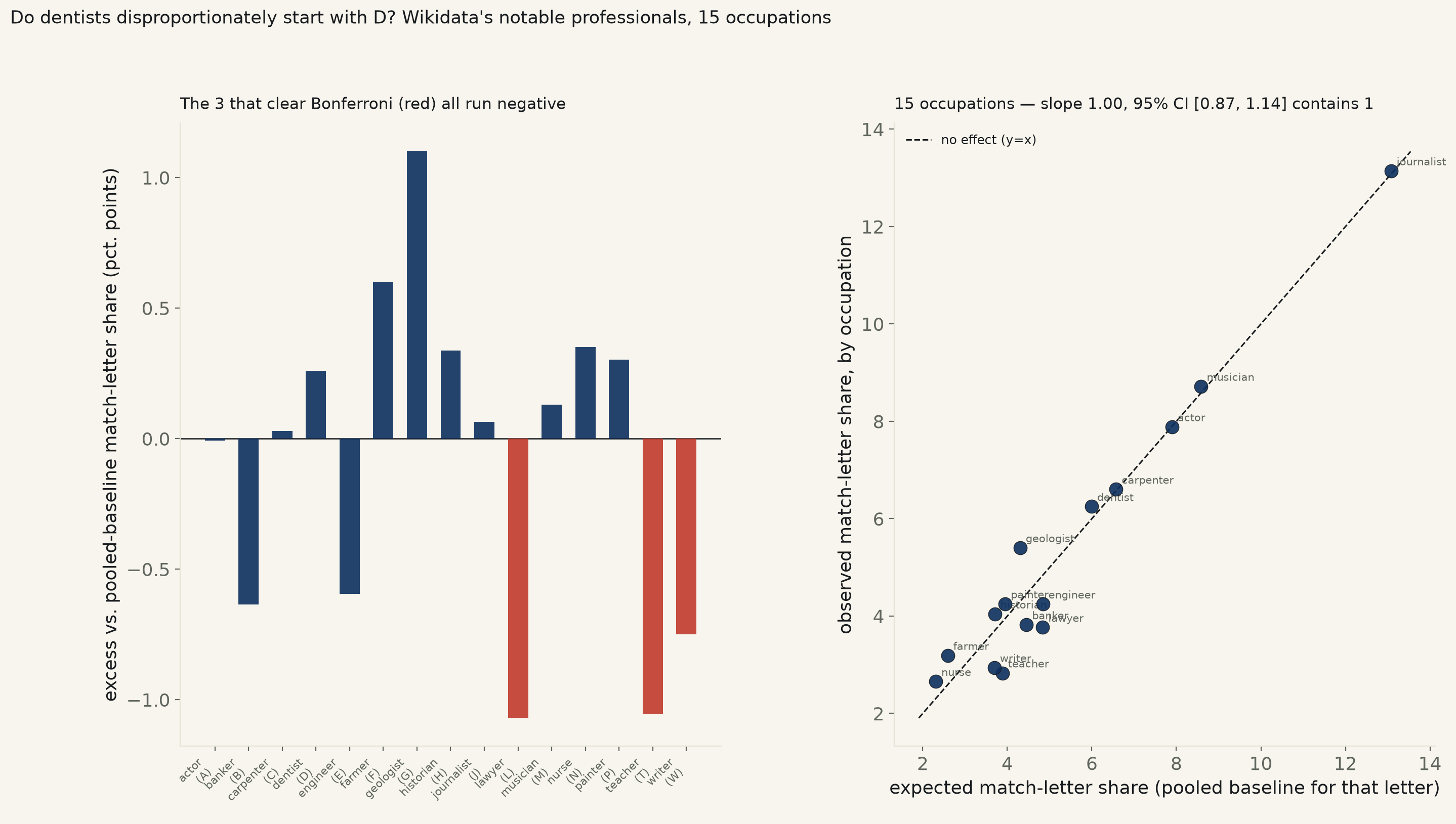
Backlog #93: nominative determinism — "do Dennises become dentists?" — the claim, from Pelham, Mirenberg & Jones' 2002 "implicit egotism" paper, that people are disproportionately drawn to things resembling their own name, including their own first initial. The published version is usually one cherry-picked pair (Dennis/dentist, Laura/lawyer). This run tests the general form systematically: 15 occupations chosen for having unambiguous, distinct first letters in English (actor, banker, carpenter, dentist, engineer, farmer, geologist, historian, journalist, lawyer, musician, nurse, painter, teacher, writer), pulled live from Wikidata for every person with that occupation (P106) and citizenship (P27) in the US, UK, Canada, Australia, Ireland, or New Zealand — 300,304 people in total — grouped by the first letter of their English Wikidata label. Each occupation's "expected" match-letter rate is computed leave-one-out, from the other 14 occupations' pooled letters only, so no occupation's own people inflate its own baseline (actor alone is 23% of the full pool, large enough for that self-inclusion to matter if left uncorrected; the naive self-inclusive version is reported alongside and agrees to three decimal places, in the specification table below).
The naive omnibus test says the effect is everywhere, overwhelmingly. Summing each occupation's squared deviation from its own baseline into one chi-square statistic, 15 degrees of freedom: χ²=262.4, p<10−45 — a rejection of "no effect" so total it would read as airtight confirmation of nominative determinism on its own. It isn't: every single occupation's deviation from its own baseline is under 1.1 percentage points — the single largest, geologist, runs +1.10 points against an expected share of 4.3%. At N in the hundreds of thousands, a chi-square has the power to flag a one-point wobble as cosmically significant, the same lesson run 569 found testing zodiac signs against career.
Rebuilt as the regression this desk actually reports, the result reverses. There are only 15 independent occupation-categories in this test, not 300,304 independent people — so the honest fit regresses each occupation's observed match-letter share on its leave-one-out expected share across those 15 points, where the no-effect prediction is a slope of exactly 1. The fit cannot rule that out: slope 1.00, 95% CI [0.87, 1.14] (p=0.94 vs. slope=1), R²=0.952. The naive self-inclusive baseline gives the same answer: slope 1.00, CI [0.88, 1.13]. A simpler paired check agrees: the mean excess across all 15 occupations is -0.062 percentage points, 95% CI [-0.412, +0.287] — contains zero.
Per-occupation, after a Bonferroni correction for testing all 15 occupations, exactly 3 still clear p<0.05 — and all three run the wrong way for the claim. Lawyers are 1.07 points below their leave-one-out expected L-rate (z=-9.5, p<10−20); teachers run 1.05 points below their expected T-rate (z=-5.70, p=1.2×10⁻⁸); writers run 0.75 points below their expected W-rate (z=-10.1, p<10−23). Nominative determinism predicts an excess toward the matching letter. What actually clears significance, at this N, is three separate deficits — lawyers under-represented among L-names, teachers under-represented among T-names, writers under-represented among W-names. Dentist itself, the backlog's own named example, shows a small positive excess (+0.26 points) nowhere near clearing significance (p=1.00 after correction).
Read plainly: no occupation in this test shows the predicted match-letter excess at a level this desk would call real. The handful of individually "significant" results run backward from the claim, not toward it, and the regression sized to the actual number of occupations being compared — not the inflated count of people inside them — cannot exclude a slope of 1, no effect. This does not rule out implicit egotism as a real, smaller phenomenon than the famous anecdotes suggest, or as something that shows up in non-notable populations differently than it does among Wikidata's pool of actors, journalists, and lawyers — stated as a limit below, not quietly dropped.
| Baseline | n | Slope (observed vs. expected match-rate) | 95% CI | R² | p vs. slope=1 | Verdict |
|---|---|---|---|---|---|---|
| Leave-one-out baseline (reported) | 15 | 1.0046 | [0.8691, 1.1402] | 0.9517 | 0.943 | contains 1 |
| Naive self-inclusive baseline | 15 | 1.0036 | [0.8764, 1.1309] | 0.9572 | 0.952 | contains 1 |
| Occupation | Match letter | n | Observed n | Observed % | Expected % (LOO) | Excess (pts) | z | p (Bonferroni) | |
|---|---|---|---|---|---|---|---|---|---|
| actor | A | 67,899 | 5,356 | 7.888% | 7.895% | -0.007 | -0.07 | 1 | |
| banker | B | 2,514 | 96 | 3.819% | 4.453% | -0.635 | -1.54 | 1 | |
| carpenter | C | 424 | 28 | 6.604% | 6.573% | +0.030 | +0.03 | 1 | |
| dentist | D | 752 | 47 | 6.250% | 5.991% | +0.259 | +0.30 | 1 | |
| engineer | E | 9,470 | 402 | 4.245% | 4.840% | -0.595 | -2.70 | 0.105 | |
| farmer | F | 5,141 | 164 | 3.190% | 2.589% | +0.601 | +2.71 | 0.0994 | |
| geologist | G | 2,591 | 140 | 5.403% | 4.304% | +1.100 | +2.76 | 0.0873 | |
| historian | H | 14,800 | 598 | 4.041% | 3.703% | +0.338 | +2.17 | 0.444 | |
| journalist | J | 29,879 | 3,927 | 13.143% | 13.078% | +0.065 | +0.33 | 1 | |
| lawyer | L | 36,373 | 1,370 | 3.767% | 4.836% | -1.070 | -9.51 | 0 | ✱ |
| musician | M | 27,579 | 2,404 | 8.717% | 8.586% | +0.131 | +0.78 | 1 | |
| nurse | N | 2,145 | 57 | 2.657% | 2.307% | +0.350 | +1.08 | 1 | |
| painter | P | 25,241 | 1,073 | 4.251% | 3.949% | +0.302 | +2.46 | 0.206 | |
| teacher | T | 10,885 | 308 | 2.830% | 3.884% | -1.055 | -5.70 | 1.85e-07 | ✱ |
| writer | W | 64,611 | 1,901 | 2.942% | 3.692% | -0.750 | -10.11 | 0 | ✱ |
✱ clears p<0.05 after a Bonferroni correction for testing all 15 occupations.
Method. Source: Wikidata Query Service, live SPARQL, keyless. For each of 15 occupations (QIDs: actor Q33999, banker Q806798, carpenter Q154549, dentist Q27349, engineer Q81096, farmer Q131512, geologist Q520549, historian Q201788, journalist Q1930187, lawyer Q40348, musician Q639669, nurse Q186360, painter Q1028181, teacher Q37226, writer Q36180), every human item with that occupation (P106) and citizenship (P27) in the US, UK, Canada, Australia, Ireland, or New Zealand, grouped server-side by the first letter of the person's English-language Wikidata label. One query per occupation (a single combined 15-occupation query exceeded the public endpoint's request budget and timed out). "First letter of the English label" stands in for first name, since Wikidata's dedicated given-name property (P735) has too little coverage to query directly; citizenship is restricted to Anglophone countries to keep that substitution reasonably accurate and to match the claim's own English-language framing. Each occupation's expected match-letter rate is computed leave-one-out (the other 14 occupations' pooled letter counts, excluding the occupation's own), not from the full self-inclusive pool, since the largest occupation (actor) alone is 23% of the combined 300,304-person sample. Per-occupation significance via a two-proportion z-test against that leave-one-out baseline, Bonferroni-corrected for testing 15 occupations; the headline regression is observed share on expected share across the 15 occupations, same design as run 569's zodiac-sign regression, where slope=1 is the no-effect prediction.
Limits, stated plainly. Wikidata's notable-people pool is not a random sample of any population, English-speaking or otherwise — it over-represents some countries, eras, and record-keeping conventions, the same caveat run 569 and run 530 both carry. Using the first token of an English Wikidata label as a stand-in for first name will misread mononyms, titles, and the small share of Anglophone-citizenship people whose Wikidata label is not name-ordered; this was not hand-audited row by row. Fifteen occupations is a deliberately broader test than the original single cherry-picked pair, but it is still a convenience sample of occupations with unambiguous distinct English first letters, not an exhaustive or randomly chosen set — a different 15 could in principle fit differently, and this run does not check that. This tests occupation as recorded on Wikidata only, not any of the follow-on implicit-egotism claims (store choice, city of residence, spouse's name) the original research program also made.
nameletters_574.csv (375 rows: occupation × letter × count) · fit output (JSON).