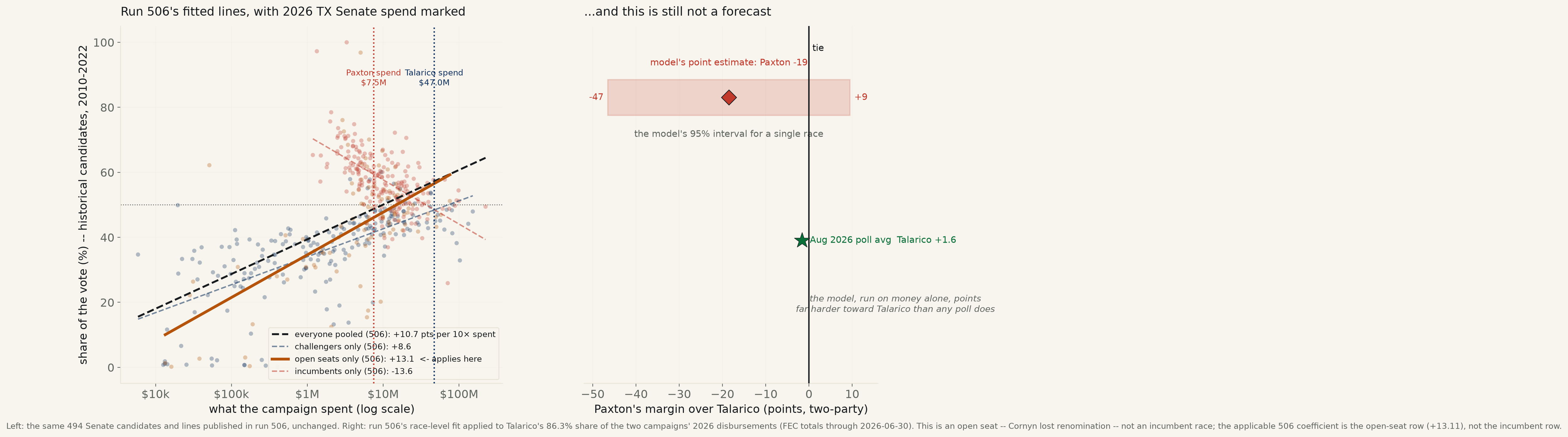
Run 506 fitted a Senate open-seat coefficient of +13.11 points per tenfold spent and published it. This run applies it, unrefit, to a live race: Cornyn lost renomination to Paxton in the May 2026 GOP runoff, so by the FEC's own coding this is an open seat, not an incumbent race. Talarico's 86.3% share of the two campaigns' money returns a point estimate of Paxton -18.5 and a 95% interval 56 points wide — far outside current polling. Reported Musk spending sits entirely outside what any of this was fitted on.

Ken Paxton is Texas’s sitting Attorney General, a decade-plus in statewide office — exactly the resume that invites calling him “the incumbent” by reputation. He is not. John Cornyn is the sitting US Senator holding the seat on the 2026 ballot, and lost 2026-05-26 GOP runoff to Paxton 63.8%-36.2%, off Nov ballot — the first sitting Texas Republican senator to lose renomination (Texas Tribune, Houston Public Media, Al Jazeera). Cornyn is off the November ballot. The FEC’s own incumbent_challenge field for the 2026 cycle codes Challenger for both Paxton and Talarico, because neither is the seat’s incumbent. By run 505 and 506’s own definition (ici == "O", no incumbent present in the general), this is an open seat. Applying run 506’s incumbent coefficient here — the number a reader half-remembering “Paxton is the incumbent” would reach for — would be exactly the misclassification this desk exists to catch, so the applicable row below is the open-seat one, not the incumbent one.
Run 506 fitted this model once, on 494 Senate candidates and 215 contested races, 2010–2022, and published it. This run does not refit it. It reads run 506’s already-published open-seat coefficient (+13.11 points per tenfold spent, CI [+9.31, +16.92], n=98) and its race-level fit, and points both at one new input: Paxton and Talarico’s own 2026 FEC filings, pulled live from the same candidate-totals endpoint, coverage through 2026-06-30. Talarico raised $68.6M and spent $47.0M; Paxton raised $9.2M and spent $7.5M — Talarico’s share of the two campaigns’ combined disbursements is 86.3%, a more lopsided split than anything in run 505 or 506’s own data.
Run through run 506’s race-level “all” fit, that spend share returns a point estimate of Paxton -18.5 — Talarico ahead by 18.5 — and a 95% interval for this one race of Paxton -46.5 to +9.5, 56.0 points wide. That is within a point of the interval width run 506 got pointing the identical fit at Abbott/Hinojosa (also 56 points) — not a coincidence of either topic, a property of the formula: a single-race prediction interval is dominated by the model’s own residual spread, not by how extreme the input spend share is. A wide, moderate-R² regression fitted on money alone returns something close to this width whichever real race gets plugged into it.
Here is what that width means against the race a reader actually cares about. seven poll aggregators, Talarico ahead by 1.2-2.0 pts, avg +1.6, as of 2026-08-13 (Texas Tribune poll tracker); 11 of 12 individual polls with a stated MOE show a lead inside that MOE -- a statistical tie The money-only model’s point estimate — Talarico by 18.5 — sits far outside every one of those polls. This is the same shape of miss run 506 flagged with Abbott: the fitted relationship is real in aggregate, replicated across two disjoint sets of federal elections, and it still overshoots hard on the single contest a reader wants an answer about. A relationship solid across two hundred races and unable to resolve the next one is the ordinary condition of this kind of regression, not a defect specific to this race.
| Who is spending (run 506) | Senate: pts per 10× | 95% CI | n | Applies to Paxton/Talarico? |
|---|---|---|---|---|
| everyone pooled | +10.67 | [+9.27, +12.08] | 494 | context only |
| challengers | +8.60 | [+7.27, +9.94] | 203 | no — neither candidate is challenging a sitting incumbent |
| open seats | +13.11 | [+9.31, +16.92] | 98 | yes — this is the seat type |
| incumbents | -13.62 | [-16.19, -11.04] | 193 | no — Cornyn, the actual incumbent, isn’t running |
Cornyn, the seat's actual incumbent, lost renomination and is off the ballot — so the incumbent row above is shown for reference only, exactly the misclassification this desk exists to catch if it were used.
The point estimate sits far outside the polling average, and the interval is wide enough to contain both a Talarico landslide and a comfortable Paxton win. This is the same shape run 506 found pointing this fit at Abbott's 2026 race: a real relationship, asked a question it cannot answer alone.
Reported plans for Elon Musk’s super PAC spending are not run through any part of the model above, and they should not be — the reason needs stating as plainly as run 506 stated its Texas-governor caveat, not folded into a footnote. WIRED, per Trump officials briefed on the matter (as reported by Political Wire 2026-08-19 and San Antonio Current 2026-08-18/19); described as national midterm spend focused on 'key races, including Texas' -- no Texas-specific dollar figure has been reported
Scaled only against Paxton’s own committee spending to date, that reported range is 13.3× to 26.7× his $7.49M in disbursements (10.8× to 21.6× his receipts). Scaled against both campaigns’ combined committee spending, it is 1.8× to 3.7× as large as everything Paxton and Talarico have spent put together.
None of that money enters the regression above, and it structurally cannot. Every coefficient in run 505 and run 506 — pooled, challenger, open-seat, incumbent — was fitted exclusively on candidate committee disbursements, the only spending the FEC’s own compiled datasets expose at the row level. Independent expenditures, party committee spending and super PAC money were never in the training data for any of these slopes. The model has nothing calibrated to say about whether a dollar of outside money moves a Senate electorate the same way a dollar of the candidate’s own committee spending does, more, or less — that relationship has never been measured on this desk, on this data, at all. If Musk’s spending materializes anywhere near the reported range, it would be larger than the entire candidate-money gap the model above is built on, and the model is blind to it by construction, not by an oversight a caveat can patch.
Method. No new regression is fit here. Run 506's already-published fits (out/stats-506.json: pooled, by-incumbency-status, and race-level) are read directly and applied to a new input — Paxton's and Talarico's 2026 FEC candidate financial summaries, pulled from api.open.fec.gov/v1/candidate/<id>/totals, coverage through 2026-06-30 (most recent full quarterly report on file). Incumbency status was verified two ways before any arithmetic: the FEC's own incumbent_challenge field for both candidates' 2026 cycle filings, cross-checked against news reporting of the May 26 2026 runoff result, not assumed from either candidate's public profile.
Limits, stated plainly. Everything run 505 and run 506 already flagged still applies unchanged: candidate committee disbursements only, no causal direction claimed, unclustered standard errors, and a wide single-race prediction interval that is a property of the fitting method, not of this particular race. Two limits specific to this run. First, this is an open seat, and the model's open-seat sample (n=98) is the smallest of the three group-level rows, so its own CI is the widest of the three. Second, and larger: reported outside spending (Musk / America PAC) is entirely outside what any of these coefficients were fitted on, addressed above rather than folded into the point estimate. The desk offers no forecast of the 2026 Texas Senate race and this run should not be cited as one.
tx_senate_2026_515.csv · fit output (JSON) · senate_money_votes.csv (run 506's underlying data, reused unchanged).
out/stats-506.json, published 2026-08-14.