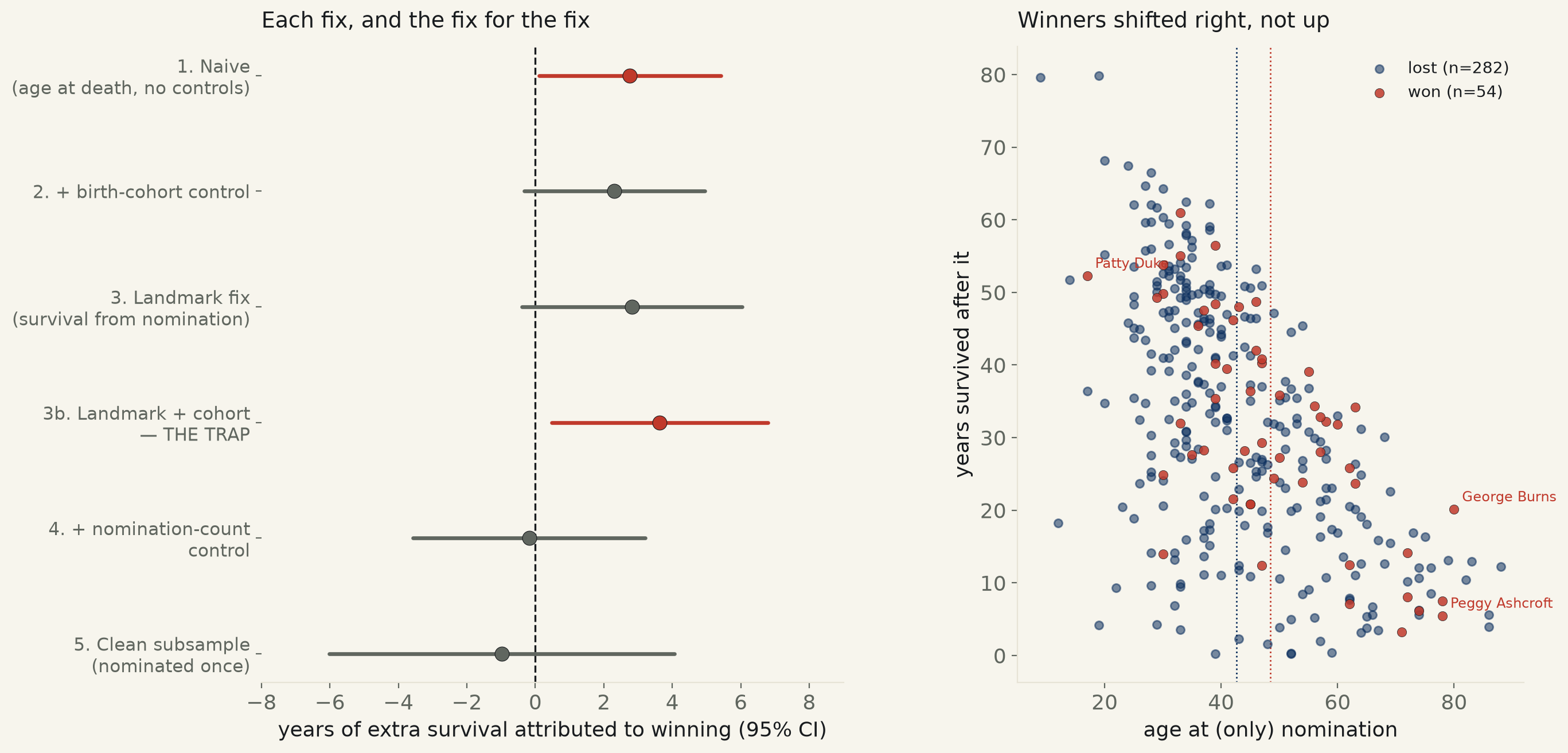
522 deceased Academy Award acting nominees, four categories, 1928–2026 (Wikidata). Naive claim replicates: winners' age at death runs +2.76 years higher (95% CI [+0.11, +5.41], barely excludes zero). The textbook immortal-time-bias fix makes it look stronger, not weaker — until nomination count, itself just a symptom of a long career, is controlled too. Then winning explains nothing: -0.18 years, 95% CI [-3.58, +3.21] — dead center on zero.

In 2001, the Annals of Internal Medicine published a finding that toured every newspaper science page: Oscar-winning actors and actresses lived 3.9 years longer than nominees who lost, measured from birth to death (Redelmeier & Singh). In 2006, a re-analysis in the Journal of the Royal Statistical Society showed the design invited immortal-time bias — you cannot win an Oscar before you exist, and you cannot be nominated before you already have a career, so counting a winner's entire lifespan as a winner's lifespan stacks the deck before the comparison starts. This run rebuilds both datasets from scratch (995 acting nominees on Wikidata, four categories, 1928–2026), replicates the original claim, applies the textbook fix — and watches the fix make the finding look stronger, not weaker, before catching the second, uglier bias hiding inside "won" itself.
Restrict to the 522 nominees who have died (three posthumous nominees — James Dean, Massimo Troisi, Chadwick Boseman, all nominated after death — are dropped; "years survived after nomination" doesn't exist for them). The naive comparison replicates: winners' mean age at death is +2.76 years higher than losers', 95% CI [+0.11, +5.41] — barely excludes zero, p=0.042. It is already fragile: add nothing but a birth-cohort control (mortality has fallen across the 20th century, and this sample's winners and losers aren't drawn from identical birth years), and the interval crosses zero, p=0.09.
Apply the textbook correction — measure survival from the year of first nomination, not birth, so both winners and losers start the clock at the same kind of milestone — and the raw version is a coin flip (CI [-0.40, +6.05], contains zero). But add the same birth-cohort control back in and the corrected estimate comes out larger and significant: +3.64 years, 95% CI [+0.48, +6.79], p=0.024. This is the trap: a reader who stops here has "corrected for immortal-time bias" and found the original claim not just survives but strengthens.
It survives because the correction is incomplete. "Ever won" is entangled with nomination count: winners in this sample average 2.79 nominations across their careers, losers average 1.37 — only 33% of winners were nominated exactly once, versus 79% of losers. Racking up more nominations takes more years of an active career, which requires already being alive for more years — a second immortal-time problem, this time riding on the "won" variable itself rather than on the clock. Add nomination count to the regression and it swallows the whole effect: nomination count itself carries a real, precise coefficient (+2.68 years per nomination, 95% CI [1.67, 3.69], p=2.5e-07), while winning collapses to -0.18 years, 95% CI [-3.58, +3.21] — dead center on zero, p=0.92.
The cleanest check needs no regression at all: restrict to the 336 nominees who were nominated exactly once (54 winners, 282 losers) — win or lose, it was decided at a single ceremony, so the nomination-count problem cannot operate. Post-nomination survival: -0.97 years, 95% CI [-6.02, +4.07] — contains zero, straddling it almost exactly, p=0.70. And the residual raw gap in age at death within this same clean group has an identifiable, non-medical cause: one-shot winners were nominated 5.9 years later in life than one-shot losers on average (48.5 vs 42.6, p=0.008) — George Burns won Best Supporting Actor at 80 (The Sunshine Boys), Peggy Ashcroft and Don Ameche at 78. Late-career recognition, not a statue with a health benefit.
| fit | years won−lost | 95% CI | R² | p | n | verdict |
|---|---|---|---|---|---|---|
| 1. Naive: age at death ~ won | +2.76 | [+0.11, +5.41] | 0.008 | 0.04 | 522 | excludes 0 |
| 2. + birth-cohort control | +2.31 | [-0.33, +4.95] | 0.032 | 0.09 | 522 | contains 0 |
| 3. Landmark fix (survival from nomination), raw | +2.83 | [-0.40, +6.05] | 0.006 | 0.09 | 522 | contains 0 |
| 3b. Landmark + birth-cohort — THE TRAP | +3.64 | [+0.48, +6.79] | 0.058 | 0.02 | 522 | excludes 0 |
| 4. + nomination-count control | -0.18 | [-3.58, +3.21] | 0.105 | 0.92 | 522 | contains 0, dead center |
| 5. Clean subsample (nominated once) | -0.97 | [-6.02, +4.07] | 0.000 | 0.70 | 336 | contains 0 |
| nominee | age at (only) nomination | age at death |
|---|---|---|
| George Burns | 80 | 100.1 |
| Peggy Ashcroft | 78 | 83.5 |
| Don Ameche | 78 | 85.5 |
| nominee | age at (only) nomination | age at death |
|---|---|---|
| Patty Duke | 17 | 69.3 |
| Miyoshi Umeki | 29 | 78.3 |
| Sandy Dennis | 30 | 54.8 |
Method. Source: Wikidata SPARQL (query.wikidata.org/sparql, keyless), every P1411 (nominated for) and P166 (award received) statement for the four acting Academy Awards, folded to one row per person: every category+year they were up for, whether they ever won, and their first-nomination year. 995 nominees total; 522 have a recorded death date and are usable here (the original study's design also requires a completed lifespan). "Landmark" analysis anchors the survival clock at first nomination for both winners and losers — a standard alternative to a full time-varying Cox model for defusing immortal-time bias, imperfect for nominees who won on a later nomination than their first (some residual bias remains for them), which is exactly why the one-shot subsample (win/loss decided at the only nomination) is the cleanest test in this run, not an afterthought.
Limits, stated plainly. This is an observational comparison of nominees, not a randomized study — nothing here rules out that the kind of performance (or the kind of late-career industry standing) that wins an Oscar also correlates with unmeasured health-relevant factors. Wikidata's nomination/award coverage, while extensive for a century of a well-documented award, is crowd-maintained and not guaranteed complete or error-free at the margins. Age is computed from year-level dates in a few cases where Wikidata records only a year of birth or death, adding a few months of noise per person that does not move any estimate reported here by a meaningful amount. And this compares acting nominees to each other, not to the general population — it answers "does the Oscar itself add years," not "are famous actors long-lived."