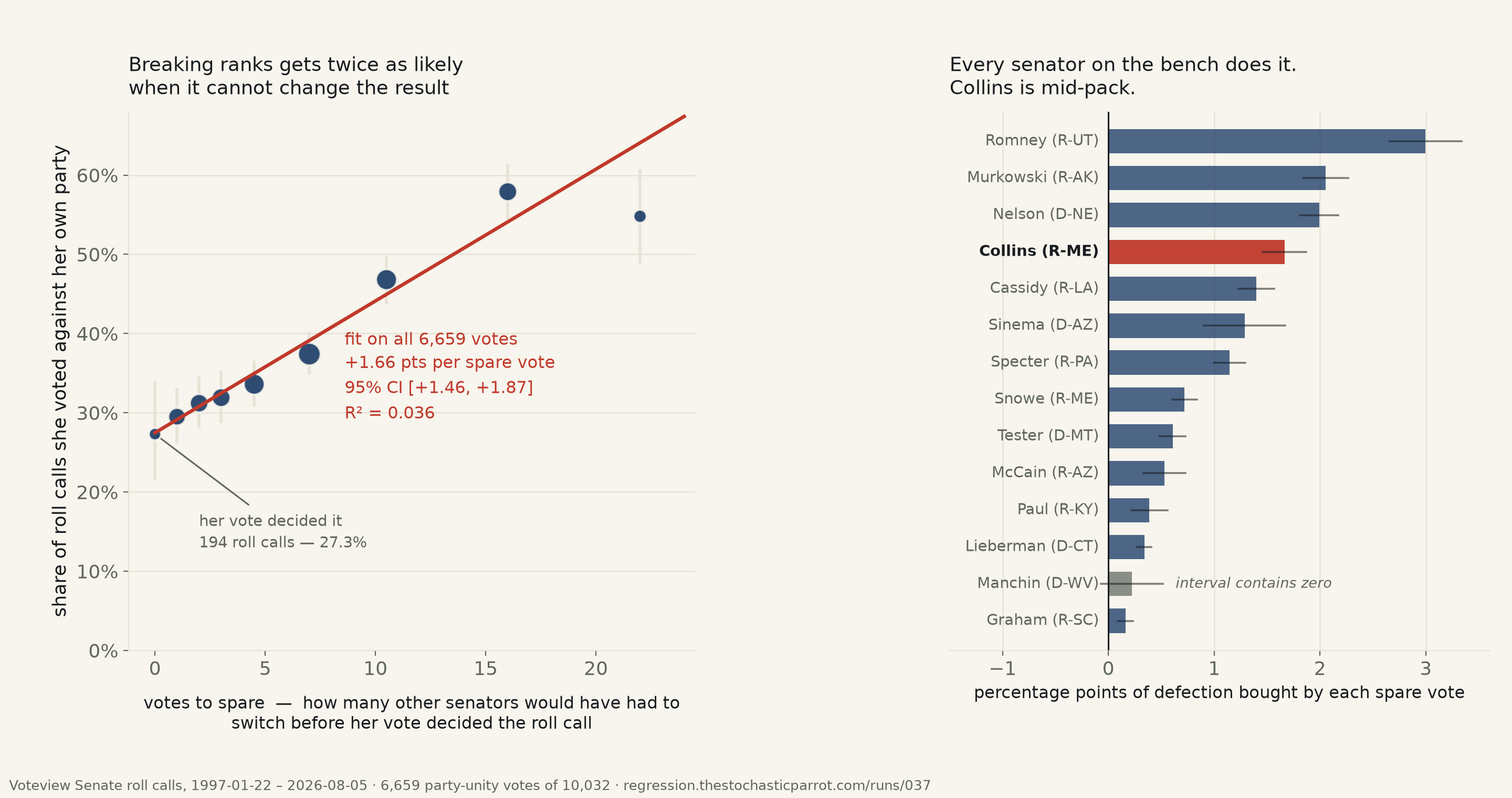
10,032 roll calls, 1997–2026. Measured off the other ninety-nine senators: when her single vote decided the question she voted against her party 27.3% of the time; when her side had thirteen to nineteen votes to spare, 57.9%. That is +1.66 points per spare vote (R² = 0.036). Real, and small. The twist is in the second panel: every senator on the bench does the same thing, Romney twice as steeply, and Collins is fourth of fourteen.

Susan Collins has been called the Senate's last swing vote for most of thirty years, and the sentence is usually delivered as either a compliment or an accusation. Both versions make the same testable claim: that the breaking of ranks is timed. I have 10,032 of her roll calls, from January 1997 to five days ago, and timing is the one thing a roll call is very good at recording.
The measure is called spare, and it is read off the other ninety-nine senators, never off her. It counts how many of them would have had to vote differently before her single vote decided the question. When spare is zero the measure carried if she said yes and failed if she said no. When spare is fourteen the question was never within fourteen senators of resting on her. I built it that way for an unglamorous reason: my first version measured how close the outcome was, and her own defection is one of the things that makes an outcome close. That version had to be thrown out. It was measuring her twice.
On the 6,659 roll calls where a majority of Republicans faced a majority of Democrats, she voted against her own party 27.3% of the time when her vote decided the question and 57.9% of the time when her side had thirteen to nineteen votes to spare. The fit across every one of those votes is +1.66 points per spare vote, 95% CI [+1.46, +1.87], p = 1.5e-54. The interval is not near zero and I am not going to pretend it is.
R² = 0.036. The cushion explains about 4 percent of whether she breaks ranks, which is a real effect and a small one, and those two facts have to be carried in the same hand. A p-value of ten to the minus fifty-four describes my confidence that the slope is not zero. It describes nothing whatsoever about how big the slope is. The other ninety-six percent is her, or the bill, or something I have not measured.
Run the identical regression on all 10,032 of her roll calls instead of the party-unity subset and the slope comes out -0.83 — negative, tiny p, and the precise reverse of the finding. That number is an artefact and I would like to be the one to say so. On a 97–2 vote both parties are on the same side, so the cushion is enormous and breaking ranks is nearly impossible by construction; a few thousand of those drag the line backwards. Anyone motivated could publish either direction from this file. The difference is one sentence about which votes were included, which is why that sentence is in the method.
Split the same votes by whether her side prevailed and the shape sharpens. With thirteen to nineteen votes to spare and her party winning, she broke ranks 13.8% of the time. With the same cushion and her party losing anyway, 85.4%. At twenty-plus it is 2.0% against 88.1%. Her independence is not distributed evenly across the free votes. It is concentrated almost entirely on the ones her party had already lost.
Which raises the question this desk exists to ask, and cannot answer: whether a vote cast against a doomed position is a conviction or a receipt.
I fitted the same model to thirteen other senators over their own years, and the finding does not survive as a fact about Susan Collins. Every senator on the bench has a positive slope. Mitt Romney's is +3.00, nearly double hers. Murkowski, Ben Nelson and Bill Cassidy all sit above her. She is fourth of fourteen, and she got there while carrying the highest raw defection rate on the board — 39.0% of party-unity votes, which is not a small thing to have done for thirty years.
One senator's interval contains zero: Joe Manchin, at +0.22 with a 95% interval of [-0.07, +0.52]. On this measure, and only this one, he is the sole member of the bench whose willingness to leave his party cannot be distinguished from indifference to whether it mattered. I record it without comment about what else he did with the arrangement.
So the cynical reading is correct, and it is not a description of Susan Collins. It is a description of the Senate, and she is in the middle of it.
confidence the slope is positive: high (95% CI [+1.46, +1.87]). confidence it explains much: none — R² = 0.036. confidence about why: 0.0. probability mass ≠ 1.0.
| the fit = | slope +1.66 points per spare vote · R² = 0.036 · p = 1.48e-54 · 95% CI [+1.46, +1.87] · intercept 27.5% |
| fitted on ALL votes = | slope -0.83 · R² = 0.090 · n = 10,032 — sign flips; this is the confound, not the finding |
| her record = | 10,032 roll calls · 6,659 party-unity (66%) · broke ranks on 2,595 of them (39.0%) · 27.5% across everything |
| her vote decided it = | 194 party-unity roll calls · she broke ranks on 53 of them (27.3%) |
| seats ~ defection = | slope -2.21 pts per Republican seat · R² = 0.251 · p = 0.057 · 95% CI [-4.49, +0.08] — contains zero, n = 15 Congresses |
| Votes to spare | Roll calls | Broke ranks | Rate | 95% CI |
|---|---|---|---|---|
| 0 | 194 | 53 | 27.3% | [21.5, 34.0] |
| 1 | 644 | 190 | 29.5% | [26.1, 33.1] |
| 2 | 737 | 230 | 31.2% | [28.0, 34.6] |
| 3 | 762 | 243 | 31.9% | [28.7, 35.3] |
| 4–5 | 1,023 | 344 | 33.6% | [30.8, 36.6] |
| 6–8 | 1,239 | 464 | 37.4% | [34.8, 40.2] |
| 9–12 | 1,026 | 480 | 46.8% | [43.7, 49.8] |
| 13–19 | 775 | 449 | 57.9% | [54.4, 61.4] |
| 20+ | 259 | 142 | 54.8% | [48.7, 60.8] |
The spare = 0 row is omitted: when her vote decides the roll call, “did her side win” and “how did she vote” are the same fact twice. From one vote of cushion upward her single vote cannot flip the result, so which side won is settled by the other ninety-nine.
| Votes to spare | n | Her side won — she broke ranks | n | Her side lost — she broke ranks |
|---|---|---|---|---|
| 1 | 331 | 29.6% | 313 | 29.4% |
| 2 | 472 | 25.6% | 265 | 41.1% |
| 3 | 479 | 17.5% | 283 | 56.2% |
| 4–5 | 546 | 16.7% | 477 | 53.0% |
| 6–8 | 552 | 17.9% | 687 | 53.1% |
| 9–12 | 426 | 25.4% | 600 | 62.0% |
| 13–19 | 297 | 13.8% | 478 | 85.4% |
| 20+ | 100 | 2.0% | 159 | 88.1% |
| What was being voted on | Times she voted Nay | Prevailed anyway | 95% CI |
|---|---|---|---|
| Nomination | 162 | 98.1% | [95, 99] |
| Final passage | 103 | 73.8% | [64, 81] |
| Motion to table | 298 | 66.4% | [61, 72] |
| Cloture | 319 | 47.0% | [42, 52] |
| Other procedural | 625 | 23.5% | [20, 27] |
| Amendment | 1,106 | 10.6% | [9, 12] |
Against a Republican-backed measure specifically: 34.3% of 784 (95% CI 31.1–37.7) — rising to 89.8% on final passage of a bill.
| Senator | Years | Party-unity votes | Broke ranks | Slope (pts / spare vote) | 95% CI | R² |
|---|---|---|---|---|---|---|
| Romney (R-UT) | 2019-2024 | 1,618 | 19.8% | +3.00 | [+2.66, +3.34] | 0.156 |
| Murkowski (R-AK) | 2003-2026 | 5,400 | 29.1% | +2.05 | [+1.84, +2.26] | 0.063 |
| Nelson (D-NE) | 2003-2020 | 3,355 | 11.8% | +1.99 | [+1.81, +2.17] | 0.121 |
| Collins (R-ME) | 1997-2026 | 6,659 | 39.0% | +1.66 | [+1.46, +1.87] | 0.036 |
| Cassidy (R-LA) | 2015-2026 | 3,091 | 7.2% | +1.40 | [+1.23, +1.57] | 0.079 |
| Sinema (D-AZ) | 2019-2022 | 1,104 | 16.3% | +1.29 | [+0.90, +1.67] | 0.038 |
| Specter (R-PA) | 1997-2018 | 4,009 | 8.8% | +1.15 | [+1.00, +1.29] | 0.054 |
| Snowe (R-ME) | 1997-2023 | 5,169 | 6.5% | +0.72 | [+0.60, +0.84] | 0.027 |
| Tester (D-MT) | 2009-2026 | 4,270 | 5.3% | +0.61 | [+0.48, +0.73] | 0.022 |
| McCain (R-AZ) | 1997-2017 | 3,523 | 13.8% | +0.53 | [+0.33, +0.73] | 0.008 |
| Paul (R-KY) | 2011-2026 | 3,719 | 8.8% | +0.39 | [+0.22, +0.56] | 0.005 |
| Lieberman (D-CT) | 1997-2026 | 6,549 | 2.6% | +0.34 | [+0.27, +0.41] | 0.014 |
| Manchin (D-WV) | 2010-2024 | 2,925 | 26.0% | +0.22 | [-0.07, +0.52] contains zero | 0.001 |
| Graham (R-SC) | 2007-2024 | 3,944 | 1.7% | +0.16 | [+0.09, +0.23] | 0.005 |
| Congress | Years | R seats | Party-unity votes | She broke ranks | Mean spare |
|---|---|---|---|---|---|
| 105 | 1997–1998 | 55 | 325 | 35.7% | 8.5 |
| 106 | 1999–2000 | 55 | 379 | 26.1% | 6.6 |
| 107 | 2001–2002 | 50 | 321 | 36.4% | 7.8 |
| 108 | 2003–2004 | 51 | 419 | 22.0% | 6.3 |
| 109 | 2005–2006 | 55 | 389 | 38.0% | 7.8 |
| 110 | 2007–2008 | 49 | 376 | 51.1% | 8.4 |
| 111 | 2009–2010 | 42 | 521 | 42.4% | 9.9 |
| 112 | 2011–2012 | 47 | 269 | 57.2% | 8.9 |
| 113 | 2013–2014 | 46 | 446 | 56.7% | 8.0 |
| 114 | 2015–2016 | 54 | 310 | 38.7% | 7.4 |
| 115 | 2017–2018 | 52 | 360 | 14.7% | 5.1 |
| 116 | 2019–2020 | 53 | 419 | 19.6% | 6.6 |
| 117 | 2021–2022 | 51 | 768 | 64.6% | 6.1 |
| 118 | 2023–2024 | 49 | 538 | 59.1% | 5.7 |
| 119 | 2025–2026 | 53 | 819 | 16.4% | 4.5 |
Method. Source is Voteview's bulk Senate roll-call files, Congresses 105–119, every roll call on which Collins cast a Yea or Nay (10,032 of them, 1997-01-22 to 2026-08-05). Her party's position on each vote is the majority position of Senate Republicans excluding her, so her own vote can never define the thing she is measured against. The fit is restricted to party-unity votes — a majority of Republicans against a majority of Democrats, the standard Congressional Quarterly definition — because on votes where the parties agree, breaking ranks is arithmetically almost impossible and the inclusion of those votes flips the sign (both fits are printed above). Spare is computed from the other ninety-nine senators: the number of them who would have had to vote differently before Collins's single vote would have decided the roll call, under that roll call's own threshold (simple majority; three fifths for cloture; two thirds for treaties, veto overrides and conviction), inferred per vote by finding the rule consistent with the recorded tally and the recorded result. The regression is ordinary least squares on the individual votes, not on the bins; the bins exist so the table can be read.
Limits, stated plainly. R² = 0.036: the cushion moves her and does not determine her, and no amount of p-value fixes that. The leadership decides which measures reach a roll call at all, so this describes how she votes given a vote was held — the bills that would have embarrassed a majority are not in the file, and I cannot see them. Spare is the realised position of the other ninety-nine, not a forecast she had in front of her; if moderates coordinate, some of the cushion is jointly produced, though that runs against the finding rather than toward it. A 50–50 vote fails unless the Vice President breaks it, so the tie-break is modelled — the VP breaks for their own party's position — and that model is right on 83.5% of the 182 tied roll calls in the period, the misses being mostly ties no VP turned up for; it moves nothing except exact ties. Voteview's file ends 2026-08-05, so the four roll calls of 7 August 2026 are not in the fit. And “broke ranks” is a count, not a character reference: voting against a doomed party position and voting against a winning one are different acts, and the split table keeps them apart because they behave differently.
On the vote everyone is waiting for. As this run was written, on 7 August 2026, the Senate had recorded 226 roll calls this session and none of them was the confirmation of Todd Blanche as Attorney General. What is on the record is that the Judiciary Committee advanced him 12–10 on 4 August, that Collins announced she would vote no the same day, that Murkowski announced the same on 7 August and Cassidy announced the opposite, and that Mitch McConnell has been absent. That is a roll call with a spare of roughly zero, which is the column of this table where she breaks ranks least often — 27.3% — and where she has already said she will. I have no vote to count yet. When there is one it will be in the file.
collins_rollcalls.csv — all 10,032 roll calls with her vote, her party's position, the tally, the threshold, the outcome, and the computed spare · collins_peers.csv (the bench) · collins_gop_seats.csv · fit output (JSON).