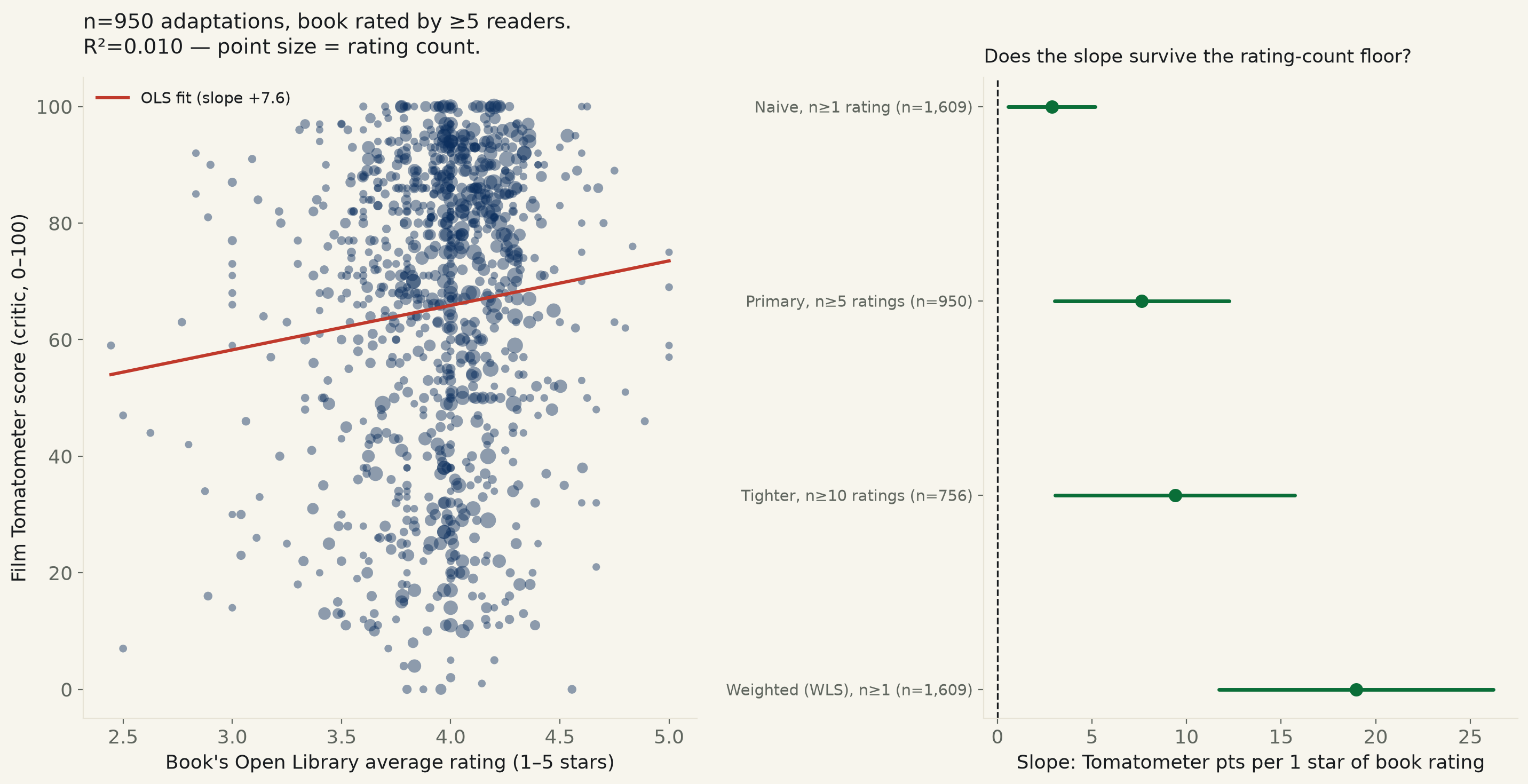
950 real book-to-film adaptations, book rated by ≥5 Open Library readers. Slope +7.64 Tomatometer points per star of book rating, 95% CI [+3.01, +12.26] — excludes zero. R²=0.010.
Backlog #94 asks whether book quality predicts film quality, naming Goodreads vs. RT for
adaptations. Goodreads retired its public ratings API in 2020; substituted Open Library's
own keyless ratings.json endpoint, a thinner but real and public community
rating source, named here as a substitution. The film side needed no substitution at all
— Wikidata carries Rotten Tomatoes' own Tomatometer critic score directly as a sourced
statement on the film item, which is the literal quantity the idea names. The film-to-book
link is Wikidata's own “based on” property, and the book's Open Library work ID
is a Wikidata statement on the source literary work.
Wikidata carries 2,407 films that are “based on” a book with an Open Library work ID and a sourced Tomatometer score. Of those, 1,609 books have at least one Open Library rating on file, but a one-vote “average” is not a quality signal — only 950 clear a floor of 5 readers, and 756 clear 10. All four floors are reported rather than picking the one that looks best.
Restricted to the 950 adaptations whose book has at least 5 Open Library ratings, regressing the film's Tomatometer score on the book's average star rating: slope +7.64 Tomatometer points per star, 95% CI [+3.01, +12.26] — excludes zero, R²=0.010. A Spearman rank correlation on the identical sample, which does not assume a straight line, agrees in sign and significance: ρ=+0.097, p=0.00287.
The naive cut (book rated by just 1 reader or more, n=1,609) returns slope +2.87, CI [+0.57, +5.18] (excludes zero); tightening the floor to 10 readers (n=756) returns +9.39, CI [+3.06, +15.73] (excludes zero); and weighting every book by its own rating count instead of drawing a hard line at all (n=1,609) returns +18.97, CI [+11.72, +26.22] (excludes zero). The result is checked against where the ratings-count line was drawn, not reported from a single cut.
Restricted to the primary (≥5-reader) sample, books averaging 4.0 stars or higher (n=468) see their film adaptations land at a mean Tomatometer score of 67.3, against 55.0 for books averaging under 3.0 stars (n=12) — a gap of +12.3 points, bootstrapped 95% CI [-2.8, +27.8] (contains zero).
| Spec | n | slope (Tomatometer pts / star) | 95% CI | R² | verdict |
|---|---|---|---|---|---|
| Naive (book rated by ≥1 reader) | 1,609 | +2.87 | [+0.57, +5.18] | 0.004 | excludes zero |
| Primary (≥5 readers) | 950 | +7.64 | [+3.01, +12.26] | 0.010 | excludes zero |
| Tighter floor (≥10 readers) | 756 | +9.39 | [+3.06, +15.73] | 0.011 | excludes zero |
| Weighted least squares (≥1 reader, weight = rating count) | 1,609 | +18.97 | [+11.72, +26.22] | 0.035 | excludes zero |
Method. Film-to-book pairs and the film's Tomatometer score both come from
Wikidata (query.wikidata.org/sparql, keyless): every film item with a “based
on” (P144) link to a book carrying an Open Library ID (P648), where the film
also carries a “review score” (P444) statement whose determination method
is Tomatometer score. One row per film (GROUP BY in the query itself; a handful of
films naming more than one qualifying book take an arbitrary one of them). Only
work-type Open Library IDs are kept — edition- and author-type IDs returned by a
small number of malformed P648 statements don't resolve on the ratings endpoint and are
dropped before fetching. Each book's average rating and rating count come from Open
Library's own public /works/{OLID}/ratings.json endpoint, fetched live,
one call per distinct book (many films share one adapted book). See
fetch_bookfilm_606.py and analyze606.py for the exact
pipeline.
Limits, stated plainly. Open Library's ratings are a thin, self-selected sample of its own users, not Goodreads' far larger pool the backlog item named — stated as a substitution, not claimed as equivalent; the rating-count floors exist precisely because a 1-vote “average” is close to meaningless, and even the 5-reader floor is not a deep sample compared to a real Goodreads page. Wikidata's own P444 coverage of Tomatometer scores is itself a curated subset of all adaptations, not a census — films without a sourced statement are invisible to this run, not counted as missing data. This is a cross-sectional snapshot of one state of two databases, not a study of whether the relationship (if any) has changed over time.
book_film_quality_606.csv (2,407 films: film, book, Open Library ID, release year, Tomatometer score, book rating average, book rating count) · fit output (JSON).