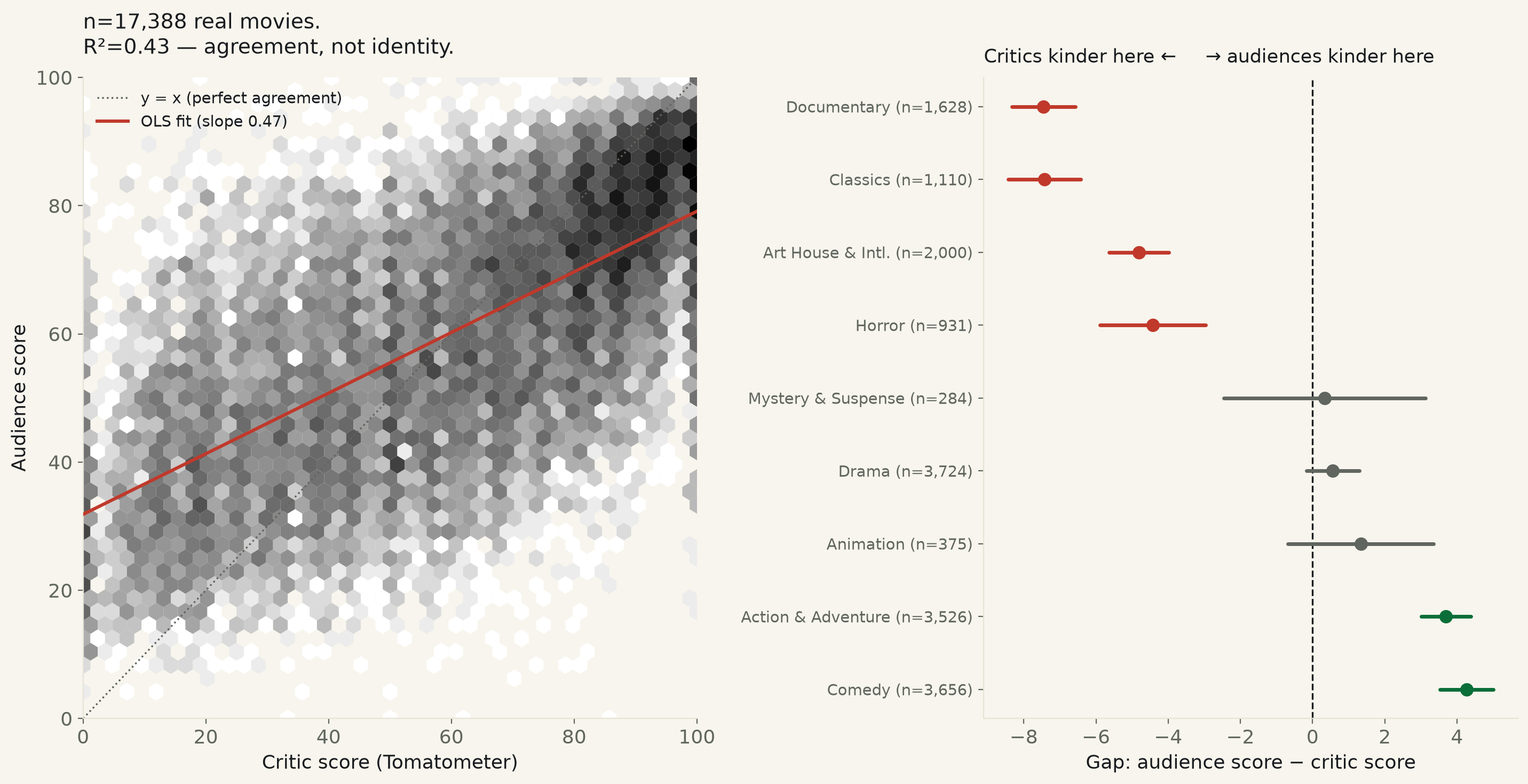
17,388 real movies, both a Tomatometer critic score and an audience score on file. Pooled: R²=0.43, average gap -0.18 pts, 95% CI [-0.50, +0.14] — contains zero. By primary genre: Documentary runs -7.45 pts critic-kinder; Comedy runs +4.27 pts audience-kinder. Both CIs exclude zero.
Backlog #86 asks whether critics and audiences diverge, and whether it varies by genre. TMDB and OMDb both need a key not on file, the block that stopped several earlier movie runs on this desk; substituted a keyless GitHub mirror of Rotten Tomatoes' own real listing data — the stefanoleone992 dataset, re-hosted by harryroper96 — 17,388 real movies carrying both a Tomatometer critic score and an audience score.
A plain regression of audience score on critic score: slope 0.47, 95% CI [0.46, 0.48] — excludes zero, R²=0.43. Critics and audiences are not measuring unrelated things; knowing the Tomatometer score explains a real 43% of the variance in the audience score, though far from all of it — a slope of 0.47, not 1, means the relationship compresses toward the middle rather than tracking one-for-one. And across the whole sample there is no net bias either direction: the average gap (audience score minus critic score) is -0.18 points, 95% CI [-0.50, +0.14] — contains zero, confirmed by a 4,000-draw bootstrap, [-0.49, +0.14]. “Audiences and critics disagree” is not true in aggregate.
Splitting the same 17,388 movies by their first listed genre (genres with fewer than 50 movies on file dropped, 8 of them, a small share), the gap moves in both directions and clears zero on either side. Critics run measurably kinder on Documentary (-7.45, 95% CI [-8.33, -6.57]) and Classics (-7.43, CI [-8.43, -6.42]), and also on Art House & International and Horror — the opposite of the usual “critics are snobs about genre movies” story for horror specifically. Audiences run measurably kinder on Action & Adventure (+3.70, CI [+3.01, +4.38]) and Comedy (+4.27, CI [+3.53, +5.01]). Drama, Mystery & Suspense, and Animation all land close to zero with a CI that contains it — no detectable divergence there. A genre-only ANOVA on the gap returns R²=0.041, p≈8.1e-152 — genre is a real predictor of the gap, but a modest one; most of a movie's critic–audience gap is not explained by its genre alone.
Restricted to movies released 2000 or later (10,679 of the 17,388), the same pattern survives for every genre with enough films on file to check: Documentary still runs critic-kinder by a similar margin, and Action & Adventure and Comedy still run audience-kinder — if anything the Action & Adventure gap widens in the modern subsample. (Classics drops below the 50-film floor once restricted to this century and is skipped, not forced.)
| Primary genre | n | mean gap (audience−critic) | 95% CI | excludes zero? |
|---|---|---|---|---|
| Documentary | 1,628 | -7.45 | [-8.33, -6.57] | yes |
| Classics | 1,110 | -7.43 | [-8.43, -6.42] | yes |
| Art House & International | 2,000 | -4.81 | [-5.64, -3.98] | yes |
| Horror | 931 | -4.42 | [-5.89, -2.96] | yes |
| Mystery & Suspense | 284 | +0.33 | [-2.46, +3.12] | no |
| Drama | 3,724 | +0.56 | [-0.17, +1.29] | no |
| Animation | 375 | +1.33 | [-0.69, +3.36] | no |
| Action & Adventure | 3,526 | +3.70 | [+3.01, +4.38] | yes |
| Comedy | 3,656 | +4.27 | [+3.53, +5.01] | yes |
| Primary genre | n (2000–) | mean gap | 95% CI | excludes zero? |
|---|---|---|---|---|
| Documentary | 1,382 | -7.38 | [-8.34, -6.43] | yes |
| Classics | 15 | n<50, skipped | ||
| Action & Adventure | 1,871 | +6.07 | [+5.11, +7.02] | yes |
| Comedy | 2,302 | +3.70 | [+2.78, +4.62] | yes |
Method. Source: a keyless GitHub mirror (harryroper96/rotten_tomatoes) of the
stefanoleone992 Kaggle dataset, itself a scrape of Rotten Tomatoes' own public listing
pages — named here as a substitution for TMDB/OMDb, which both need a key not on
file. 17,712 real movie listings; 17,388 survive after keeping only rows with both
a numeric tomatometer_rating and audience_rating (0–100) and at least one listed
genre, deduped by the source's own link id (zero duplicates found). A movie can carry
several genres (e.g. “Action & Adventure, Comedy, Drama”); this run uses
only the first listed genre as the primary genre, an explicit simplification —
multi-label attribution has no single honest way to assign one gap value per movie
otherwise. Genres with fewer than 50 movies on file are dropped from
the by-genre analysis (8 movies, under 1% of the
sample). All regressions use HC3-robust standard errors; genre-level gap intervals are
reported both analytically and via a 4,000-draw bootstrap, which agree to within rounding
throughout. See fetch_rt_critics_audience_605.py and
analyze605.py for the exact pipeline.
Limits, stated plainly. Audience scores on Rotten Tomatoes are self-selected site visitors casting a vote, not a random sample of ticket-buyers or a verified-viewer panel — a real and disclosed source of possible bias in either direction. The first-listed-genre simplification means a film billed as “Horror, Comedy” counts entirely as Horror here; a full multi-label treatment might move individual genre estimates somewhat, though the four genres with the largest gaps are dominant-genre labels (Documentary, Classics, Action & Adventure, Comedy) unlikely to be driven by second-listed tags. This is an observational snapshot of listings as scraped, not a time-resolved study of whether the gap itself has changed decade to decade beyond the single pre/post-2000 split checked above.
rt_critics_audience_605.csv (17,388 movies: title, genres, primary genre, release date, critic score, audience score) · fit output (JSON).