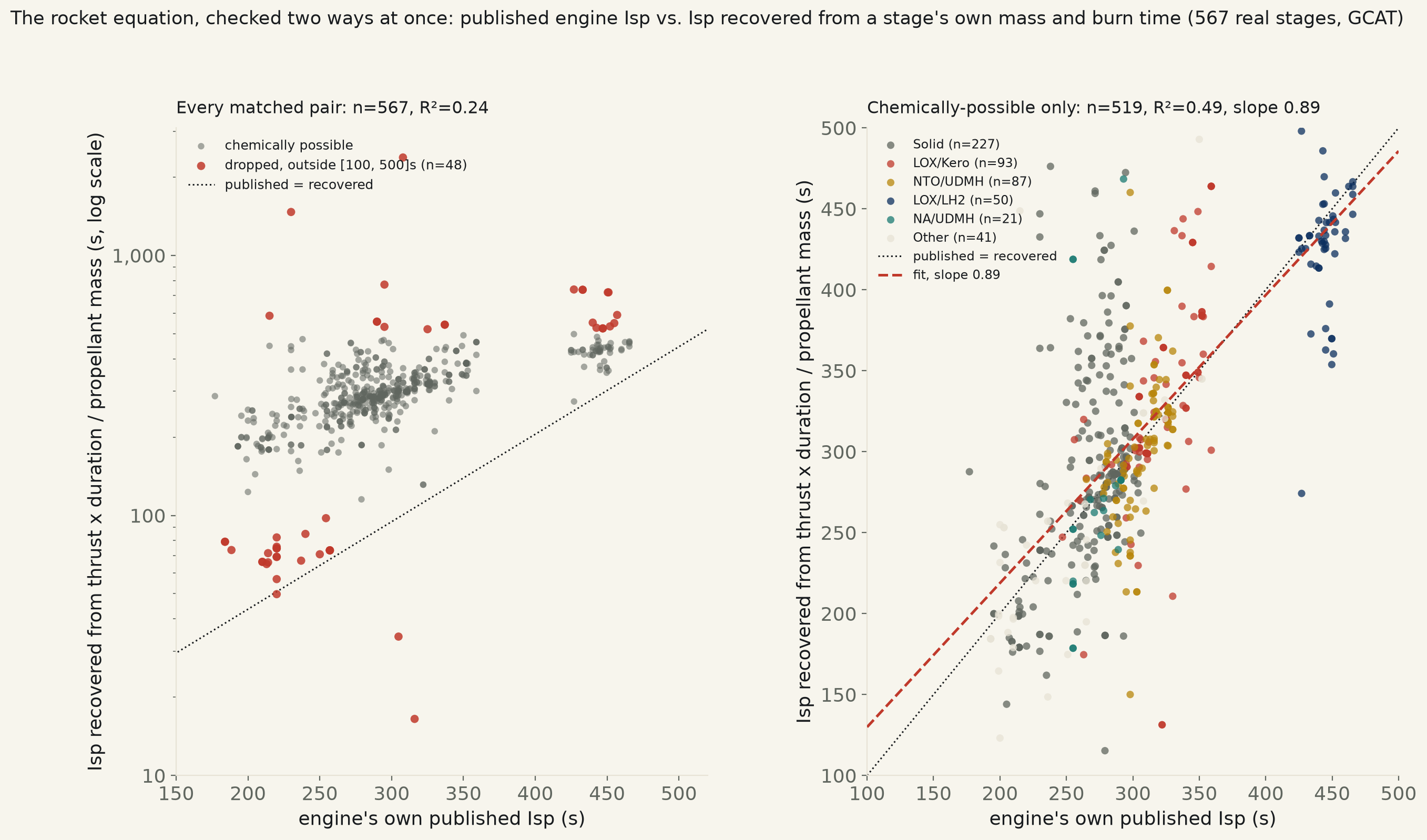
567 real rocket stages, Jonathan McDowell's GCAT, fetched live. An Isp recovered purely from a stage's own mass and burn time agrees with the engine's own published Isp at face value — slope 1.12, CI contains 1 — but only because 48 physically-impossible outliers, driven by GCAT's own acknowledged rounding, are canceling out a real, smaller mismatch underneath. Remove them and the slope is 0.889, 95% CI excluding 1.
Backlog item #60: “the Tsiolkovsky rocket equation — payload fraction vs delta-v across real rockets.” No single keyless Wikipedia launch-vehicle comparison table carries both liftoff mass and per-stage dry mass and Isp for a broad real-rocket sample, so this run substitutes Jonathan McDowell's GCAT (General Catalog of Artificial Space Objects, planet4589.org) — a keyless, publicly maintained aerospace reference already cited across the spaceflight-tracking community. GCAT's own Stages table lists, for roughly 1,600 real rocket stages, full (wet) launch mass, dry mass, total stage thrust, and nominal burn duration. Its Engines table independently lists each named engine's own publisher-quoted specific impulse (Isp). Joining stage to engine by name, and computing an “effective Isp” straight from the stage's own numbers — thrust × duration / propellant mass / g₀, the exhaust-velocity term inside the rocket equation — without ever reading the engine's own Isp, tests whether two independently maintained parts of the same reference agree on the same physical quantity.
567 stages have both a clean mass/thrust/duration triple and a matched engine Isp. Taken at face value, the agreement looks clean: slope 1.117, 95% CI [+0.951, +1.283] — cannot be told apart from 1. But R²=0.24 is weak, and the reason shows up immediately on a log scale: 48 of 567 pairs (8.5%) imply a combustion efficiency no real chemical propellant can produce — one “Isp” recovered this way tops 2,300 seconds, when the best real chemical engines top out near 470. GCAT's own documentation calls the whole database “approximate”; these are overwhelmingly small kick-stages and apogee motors where a little rounding in a duration or thrust field, divided into a tiny propellant mass, swings the recovered number by hundreds of seconds.
Restricted to a generous, chemically-possible envelope fixed before looking at which rows it would drop (100–500 seconds — spans everything from small monopropellant thrusters to hydrogen upper stages), R² roughly doubles to 0.486 (n=519) — and the slope moves to 0.889, 95% CI [+0.810, +0.969]: now excluding 1. Once the GCAT roundoff-driven extremes are out, the bookkeeping-recovered Isp runs a real, if moderate, ~11% under what the engine's own spec sheet says. A paired check agrees: the mean gap is +7.9 seconds, 95% CI [+3.2, +12.7] — excludes zero. Restricting further to single-engine stages (n=449, ruling out any mismatch between a stage's total listed thrust and one engine's own rating) moves the slope to 0.897, CI [+0.802, +0.991] — the same conclusion survives.
The gap is not uniform across propellant families. Solid motors land almost exactly on their own quoted number (slope near 1, CI contains 1) — a solid grain burns at a fixed, well-characterized rate, so thrust and duration pin down the real exhaust velocity cleanly. Kerosene-fueled liquid stages run the other way, and hard: the bookkeeping overstates their efficiency by roughly 50%. The most plausible mechanism is throttling: several kerosene-burning first stages (this sample's heaviest, most familiar vehicles among them) throttle down well before the engine's own full-power Isp rating applies — for max-dynamic-pressure control, or simply to taper acceleration as the vehicle empties — stretching the stage's listed burn duration without stretching its propellant consumption at the rated flow rate in step. Hydrogen-fueled upper stages' interval is too wide to say either way (n=50, CI contains 1).
| Specification | n | slope | 95% CI | R² | mean diff (s) | diff 95% CI |
|---|---|---|---|---|---|---|
| Full sample, every matched pair | 567 | +1.117 | [+0.951, +1.283] | 0.236 | +13.3 | [+2.8, +23.8] |
| Chemically-possible envelope only (100–500s) | 519 | +0.889 | [+0.810, +0.969] | 0.486 | +7.9 | [+3.2, +12.7] |
| NE=1 (single-engine stages) only, bounded | 449 | +0.897 | [+0.802, +0.991] | 0.437 | +9.9 | [+4.6, +15.2] |
| Propellant family | n | slope | 95% CI | R² | excludes 1? |
|---|---|---|---|---|---|
| Solid | 227 | +1.111 | [+0.824, +1.397] | 0.206 | no |
| LOX/Kero | 93 | +1.529 | [+1.135, +1.924] | 0.394 | yes |
| NTO/UDMH | 87 | +1.390 | [+0.873, +1.907] | 0.251 | no |
| LOX/LH2 | 50 | +0.755 | [-0.229, +1.739] | 0.047 | no |
| NA/UDMH | 21 | +1.168 | [-0.995, +3.330] | 0.063 | no |
| Stage | Engine | recovered Isp (s) | published Isp (s) |
|---|---|---|---|
| Ikar | 17D61 | 2379 | 308 |
| Sejjil Stage 2 | Sejjil St 2 | 1468 | 230 |
| Start | Start | 772 | 295 |
| L735 | L735 | 586 | 215 |
| H3 Stage 1 2E | LE-9 | 739 | 427 |
| DC-X | RL10 | 738 | 433 |
| DC-XA | RL10 | 738 | 433 |
| OV | AJ10-190 | 17 | 316 |
Method. Source: GCAT (planet4589.org/space/gcat),
Jonathan McDowell's General Catalog of Artificial Space Objects — the Stages and
Engines tables, fetched live at run time and parsed as fixed-width text (column
boundaries detected from character positions common to the header and every data row).
Substituted for the Wikipedia comparison table IDEAS.md named (backlog item #60) because
no single keyless Wikipedia table carries both liftoff mass and per-stage dry mass/Isp
for a broad real-rocket sample. A stage is kept if it names an engine with a positive,
numeric published Isp in the Engines table, and if its own wet mass, dry mass, thrust,
and burn duration are all present and give a positive propellant mass. “Thrust”
is the stage's own total (already summed across however many engines it carries, verified
against known multi-engine stages like the Saturn V first stage). The 100–500
second chemical-possibility bound was fixed from general rocketry knowledge (the weakest
monopropellant thrusters to the best hydrogen/oxygen upper stages) before the fit was
run, not chosen to improve it. OLS throughout (scipy.stats.linregress);
the paired mean-difference test uses a standard t-interval on the per-stage differences.
Limits, stated plainly. This is a consistency check between two columns of the same reference work, not an independent physical measurement against flight telemetry — both the “recovered” and “published” Isp figures ultimately trace back to GCAT's own editorial judgment, which the source itself calls approximate. “Burn duration” is each stage's single nominal figure, not a real flight's specific throttle profile, which is almost certainly why kerosene stages (the propellant family most associated with mid-flight throttling for max-Q control) show the largest, most one-sided gap. Multi-engine stages assume every engine of the named type contributes identically; mixed-engine stages (a different sustainer and boosters, for instance) are not represented by a single “Engine” field and are absent from this join entirely. This run does not attempt the backlog item's literal payload-fraction framing — no single GCAT or Wikipedia table reliably carries whole-vehicle liftoff mass alongside LEO payload for a large, clean sample — and instead tests the equation's exhaust-velocity term directly at the stage level.
rocket_isp_598.csv (stage, engine, propellant family, mass/thrust/duration, recovered vs. published Isp) · fit output (JSON).