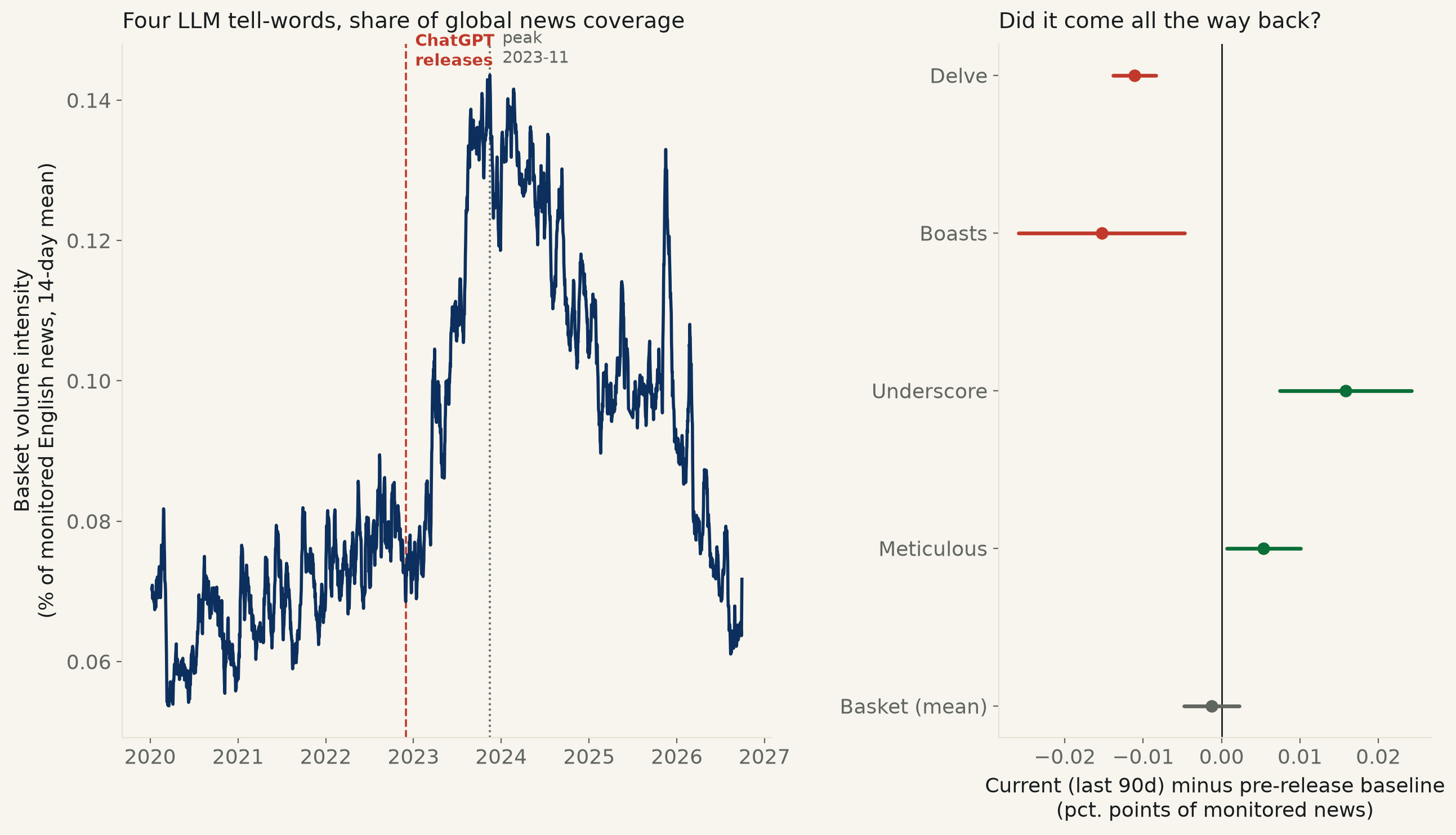
Four LLM tell-words (delve, boasts, underscore, meticulous), GDELT's own daily share of all monitored global English-language news, 2,440 days, 2020-01-01 to 2026-10-10. All four rose after ChatGPT's 2022-11-30 release, CI excluding zero for every word. The basket peaked at 1.94× baseline in 2023-11-15, and now reads as fully recovered — but that average hides delve running 31% below its own starting point and underscore sitting 30% above it.
Run 023 (2026-07-15) found a sharp, dateable break in LLM "tell-words" — delve, underscore, and eight siblings from Kobak et al. 2024's list — across 2.48 million arXiv abstracts: flat for a decade, a hinge 3.5 months after ChatGPT shipped, a peak 29× baseline, then a halving every 5.2 months, "a funeral." That run measured researchers writing abstracts, a population already primed to use AI drafting tools. Backlog idea #105 asks the harder question: did it reach ordinary published journalism, and if so, is it over there too? GDELT's DOC 2.0 API answers directly — its timelinevol mode returns, for any search term, the percent of all monitored global English-language online news coverage mentioning it, every day, already normalized against total volume. Four of run 023's tell-words — delve, boasts, underscore, meticulous — pulled live, keyless, 2,440 days, 2020-01-01 to 2026-10-10.
The single most natural test is also the misleading one. ChatGPT's public release, 2022-11-30, is pre-registered here, not fit to the data — the same date run 023 anchored to. A segmented regression with one slope before that date and one slope after finds the post-release slope lower than the pre-release slope for three of four words (basket -0.014 pts/yr, CI [-0.017, -0.010], p=1.6e-13) — which reads backward, as if the tells never took off. They did: a single post-release slope nets a roughly one-year rise against a roughly three-year decline into one misleading average, the same trap run 567's naive loudness-war fit fell into before a quadratic term exposed the turning point. Splitting the post-release window at its own data-determined peak (the basket's 14-day rolling maximum, 2023-11-15, applied uniformly to all four words and stated as a limit) tells the real story in the table above and below.
The rise is unanimous and large. From release to peak, every word's slope excludes zero: delve +0.104 pts/yr (CI [+0.092, +0.116]), boasts +0.138 (CI [+0.122, +0.154]), underscore +0.041 (CI [+0.025, +0.057]), meticulous +0.040 (CI [+0.030, +0.049]). At its peak the basket ran 1.94× its own pre-release baseline (0.1351% of monitored news vs. 0.0695%, diff CI [+0.0579, +0.0733]); delve alone peaked at 3.13× baseline.
The decline is real for three words, not four — and "back to baseline" is not what happened to any single one of them. From peak to the end of the series, delve (-0.030 pts/yr, CI [-0.033, -0.026]), boasts (-0.047, CI [-0.051, -0.043]) and meticulous (-0.009, CI [-0.011, -0.008]) all keep falling, CI excluding zero; underscore does not (-0.003, CI [-0.007, +0.001], p=0.12 — contains zero, a plateau, not a continued fall). Comparing the last 90 days on file against the pre-release baseline directly: delve now runs 31% below its own baseline (0.0241% vs. 0.0352%, diff CI [-0.0138, -0.0084] — excludes zero, the wrong direction for "recovered") and boasts 10% below (CI [-0.0259, -0.0047], excludes zero) — while underscore sits 30% above its own baseline (CI [+0.0074, +0.0242], excludes zero, the wrong direction for a funeral) and meticulous 16% above (CI [+0.0007, +0.0101], excludes zero). The basket's current-vs-baseline gap, -0.0013 points, CI [-0.0048, +0.0022], contains zero — but only because two overshoots below baseline are cancelling two residues above it, not because four words settled back to where they started.
A plausible, unproven mechanism: "delve" became the famous, widely mocked shorthand for AI-assisted writing, discussed by name in newsroom style guides and media-criticism pieces by 2023 — giving editors and writers a specific word to consciously avoid, which could overshoot the original baseline if avoidance became its own habit. "Underscore" and "meticulous" never became a meme in the same way, and show no sign of active suppression. This run cannot distinguish deliberate editorial avoidance from any other explanation for delve's and boasts's undershoot; it is stated here as the most visible candidate, not a tested one.
| Word | n (rise) | Rise, pts/yr | 95% CI | n (decline) | Decline, pts/yr | 95% CI | Current−baseline | 95% CI | Verdict |
|---|---|---|---|---|---|---|---|---|---|
| Delve | 350 | +0.104 | [+0.092, +0.116] | 1028 | -0.030 | [-0.033, -0.026] | -0.0111 | [-0.0138, -0.0084] | excludes zero |
| Boasts | 350 | +0.138 | [+0.122, +0.154] | 1028 | -0.047 | [-0.051, -0.043] | -0.0153 | [-0.0259, -0.0047] | excludes zero |
| Underscore | 350 | +0.041 | [+0.025, +0.057] | 1028 | -0.003 | [-0.007, +0.001] | +0.0158 | [+0.0074, +0.0242] | excludes zero |
| Meticulous | 350 | +0.040 | [+0.030, +0.049] | 1028 | -0.009 | [-0.011, -0.008] | +0.0054 | [+0.0007, +0.0101] | excludes zero |
| Basket (mean of 4) | 350 | +0.081 | [+0.073, +0.088] | 1028 | -0.022 | [-0.024, -0.020] | -0.0013 | [-0.0048, +0.0022] | contains zero |
Segmented regression, one slope before 2022-11-30 and one after, Newey-West HAC(7). This is the naive, pre-registered-break version shown second, deliberately, because it is misleading on its own (see prose above).
| Word | n | Single post-release slope change, pts/yr | 95% CI | p |
|---|---|---|---|---|
| Delve | 2440 | -0.017 | [-0.022, -0.012] | 1.0e-12 |
| Boasts | 2440 | -0.041 | [-0.049, -0.033] | 6.8e-24 |
| Underscore | 2440 | +0.004 | [+0.001, +0.008] | 2.6e-02 |
| Meticulous | 2440 | -0.001 | [-0.003, +0.001] | 3.1e-01 |
| Basket | 2440 | -0.014 | [-0.017, -0.010] | 1.6e-13 |
Method. GDELT DOC 2.0 API (api.gdeltproject.org/api/v2/doc/doc), mode=timelinevol, keyless, live. For each word, query <word> sourcelang:english, daily resolution, 2020-01-01 to 2026-10-10. The API's own "Volume Intensity" series is the percent of all monitored global English-language online news coverage that day mentioning the term — already a share of total volume, so no separate denominator was fetched. BASKET is the simple daily mean across the four words, same logic as run 023's ten-tell basket. The peak date (2023-11-15) is the basket's own 14-day centered rolling-mean maximum over the full window, applied identically to all four words rather than refit per word, and stated here as that choice's limit. Regressions use Newey-West HAC(7) standard errors throughout (daily series, weekly autocorrelation expected from news-cycle patterns); release-to-peak and peak-to-end windows are each fit as plain OLS trends on day-index, reported per year.
Limits, stated plainly. GDELT's "monitored" universe is its own crawl of online news, not a census of all journalism, and is skewed toward outlets GDELT's crawler reaches well — English-language, online-first, and (by GDELT's own documentation) US/UK/India/Australia-heavy. A rise in "volume intensity" for a word conflates more articles using it with more total monitored articles of any kind; both move the ratio and are not separated here. The four words are a small, hand-picked slice of Kobak et al. 2024's full list, chosen for being named in idea #105 or already characterized in run 023 — not a random sample of all LLM tells, and the basket of four should not be read as "the" AI-tell signal for journalism. The peak date is basket-determined, not per-word, which very slightly understates each word's own individual peak intensity. This measures detectability of a word, exactly as run 023 framed it — not whether any individual article was AI-written, AI-assisted, or merely echoing a style that spread by human imitation after the fact.
ai_tells_news_570.csv (9,760 rows: word × date × volume_intensity_pct) · fit output (JSON).
timelinevol mode, keyless ·
tell-word list: Kobak, González-Márquez, Horvát & Lause, "Delving into ChatGPT usage in academic writing through excess vocabulary," arXiv:2406.07016 (2024) · prior run: Run 023, this desk, 2026-07-15.