301,720 Wikidata people, live SPARQL pull: 213,363 actors, 66,926 musicians, 21,431 scientists, day-precision birth dates only, a known January-1 placeholder artifact excluded. Naive chi-square vs. a calendar-day-weighted null: p<10−5 for all three groups. The regression this desk actually reports — 12 signs, not 213,363 people — can't exclude a slope of 1 (no effect) for any of them.
Backlog #72: does your zodiac sign predict anything — specifically, does birth month sort people into careers the way sun-sign astrology claims? Wikidata carries exact birth dates for hundreds of thousands of notable people tagged by occupation, which makes this directly testable at a scale no astrologer's anecdote ever is. This run pulled every human item with occupation actor, musician, or scientist and a day-precision birth date (P569) born 1901–2009, and checked each group's birth-month distribution against the one honest null: not an equal 1-in-12 split (zodiac signs are not equal length), but the exact share of the calendar each sign's date range actually covers — 29 days for Capricorn up to 32 for Cancer. One data-quality step taken before any fit ran: January 1 carried 2.5× any other day's count in a spot-check, a known Wikidata placeholder-date pattern (an unknown exact day sometimes gets stored as day-precision January 1 instead of year-only precision) — those rows are dropped by construction, not discovered as a surprise in the results.
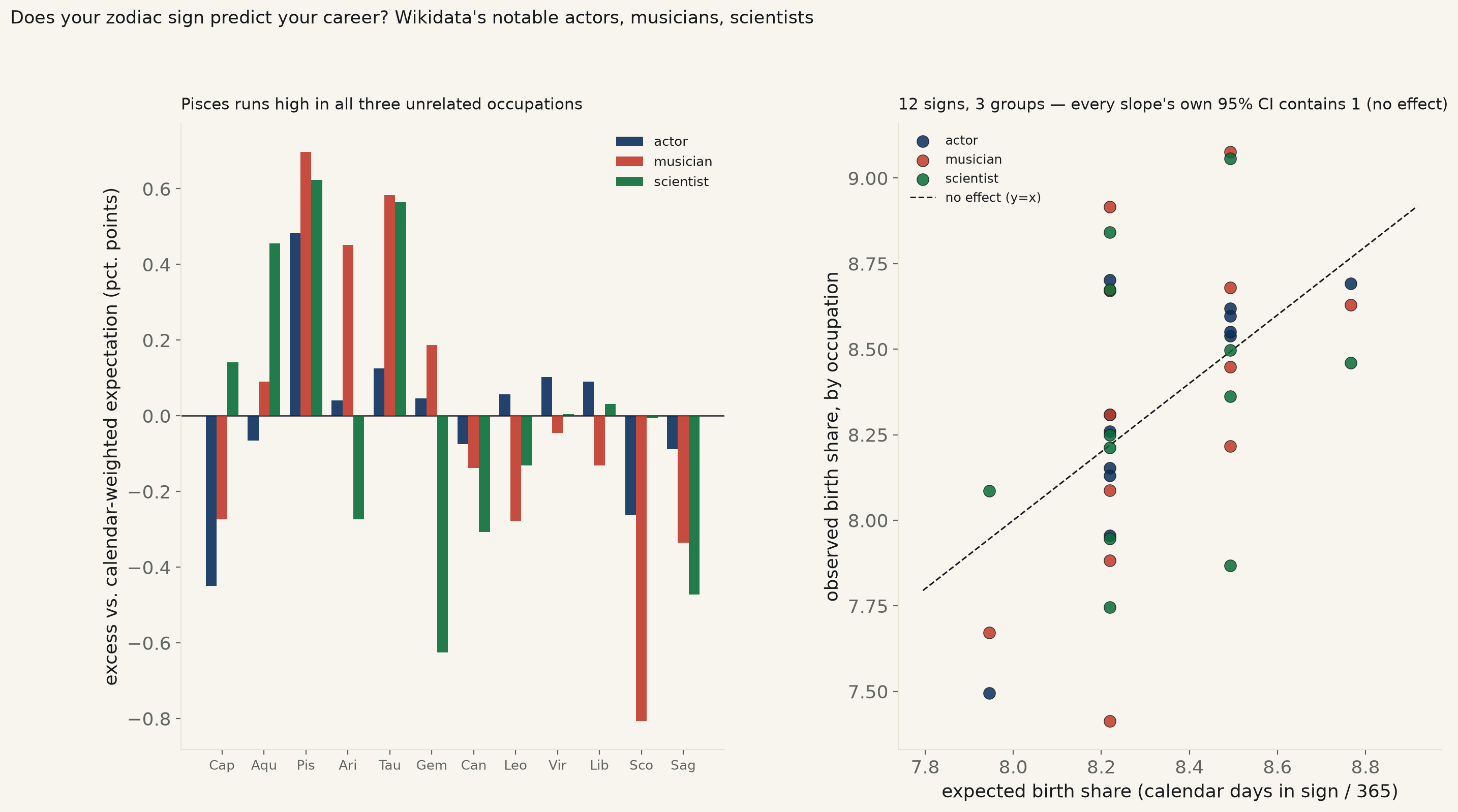
The naive test says every group is "significant," loudly. A chi-square goodness-of-fit against the calendar-weighted null rejects the no-effect hypothesis for all three occupations: actors (213,363 people) χ²(11)= 147.8, p=4.3e-26; musicians (66,926) p=2.2e-29; scientists (21,431) p=5.9e-06. Read naively, that looks like three confirmations of astrology. It isn't: every single sign's deviation from its expected share, in every group, is under 0.8 percentage points — actors' biggest gap is Pisces at +0.48 points, against an expected share of 8.2%. At N in the hundreds of thousands, a chi-square has the power to flag a quarter-point wobble as cosmically significant. That is a property of the sample size, not of the zodiac.
Rebuilt as the regression this desk actually reports, the result reverses. There are only 12 independent sign-categories in this test, not 213,363 independent trials — so the honest fit regresses each sign's observed birth share on its expected birth share across those 12 points, where the no-effect prediction is a slope of exactly 1. None of the three groups can rule that out: actors 1.33, 95% CI [+0.64, +2.03] (p=0.31 vs. slope=1); musicians 1.23, CI [-0.15, +2.62] (p=0.71); scientists 0.50, CI [-0.74, +1.74] (p=0.39). Every one of the three intervals contains 1. Per-sign, after a Bonferroni correction for testing all 12 signs in each group, a handful of individual signs do still clear p<0.05 (3 of 12 for actors, 5 for musicians, 3 for scientists) — the table below marks them — but the whole-distribution test built for the actual number of categories here says the pattern is not distinguishable from the calendar alone.
The one thing all three unrelated occupations agree on is the tell. Pisces posts the single largest excess share in every group tested — actors +0.48 points, musicians +0.70, scientists +0.62. Astrology gives no reason actors, musicians and scientists should share a sign bias — performers and researchers aren't claimed to run the same sign. A shared data artifact does give a reason: actors' and musicians' full 12-sign excess-vs-expected fingerprints correlate with each other, r=0.72, p=0.008 — close enough that whatever is nudging actors toward Pisces is very likely also nudging musicians there, rather than two independent zodiac effects landing on the same sign by chance. The scientist correlations are weaker and don't clear this desk's bar (actor–scientist r=0.30, p=0.34; musician–scientist r=0.41, p=0.19), consistent with a weaker or different version of whatever the shared skew is. The most likely source, not independently tested here: Wikidata's notable-people pool is not a random population sample, and its underlying mix of countries, eras, and record-keeping conventions could easily carry its own small birth-month skew that has nothing to do with any person's star sign.
Read plainly: no group's zodiac sign predicts its career once the test is sized to the actual 12 signs being compared, not the inflated count of people in them. The large-N chi-square's unanimous "rejection" is a lesson in statistical power, not a confirmation of astrology — and the one real cross-occupation pattern in the data points at a quirk of this particular notable-people dataset, not at anyone's birth date.
| Occupation | n | χ² (11 dof) | χ² p | Regression slope | 95% CI | R² | p vs. slope=1 |
|---|---|---|---|---|---|---|---|
| actor | 213,363 | 147.8 | 4.25e-26 | +1.33 | [+0.64, +2.03] | 0.646 | 0.311 |
| musician | 66,926 | 163.8 | 2.23e-29 | +1.23 | [-0.15, +2.62] | 0.284 | 0.713 |
| scientist | 21,431 | 44.5 | 5.87e-06 | +0.50 | [-0.74, +1.74] | 0.075 | 0.391 |
| Occupation | Sign | Days | Observed n | Observed % | Expected % | Excess (pts) |
|---|---|---|---|---|---|---|
| actor | Capricorn | 29 | 15,992 | 7.495% | 7.945% | -0.450 ✱ |
| actor | Aquarius | 30 | 17,395 | 8.153% | 8.219% | -0.066 |
| actor | Pisces | 30 | 18,566 | 8.702% | 8.219% | +0.482 ✱ |
| actor | Aries | 30 | 17,622 | 8.259% | 8.219% | +0.040 |
| actor | Taurus | 31 | 18,389 | 8.619% | 8.493% | +0.125 |
| actor | Gemini | 31 | 18,219 | 8.539% | 8.493% | +0.046 |
| actor | Cancer | 32 | 18,546 | 8.692% | 8.767% | -0.075 |
| actor | Leo | 31 | 18,243 | 8.550% | 8.493% | +0.057 |
| actor | Virgo | 31 | 18,340 | 8.596% | 8.493% | +0.103 |
| actor | Libra | 30 | 17,728 | 8.309% | 8.219% | +0.090 |
| actor | Scorpio | 30 | 16,975 | 7.956% | 8.219% | -0.263 ✱ |
| actor | Sagittarius | 30 | 17,348 | 8.131% | 8.219% | -0.088 |
| musician | Capricorn | 29 | 5,134 | 7.671% | 7.945% | -0.274 |
| musician | Aquarius | 30 | 5,561 | 8.309% | 8.219% | +0.090 |
| musician | Pisces | 30 | 5,967 | 8.916% | 8.219% | +0.697 ✱ |
| musician | Aries | 30 | 5,803 | 8.671% | 8.219% | +0.452 ✱ |
| musician | Taurus | 31 | 6,074 | 9.076% | 8.493% | +0.583 ✱ |
| musician | Gemini | 31 | 5,809 | 8.680% | 8.493% | +0.187 |
| musician | Cancer | 32 | 5,775 | 8.629% | 8.767% | -0.138 |
| musician | Leo | 31 | 5,499 | 8.217% | 8.493% | -0.277 |
| musician | Virgo | 31 | 5,654 | 8.448% | 8.493% | -0.045 |
| musician | Libra | 30 | 5,413 | 8.088% | 8.219% | -0.131 |
| musician | Scorpio | 30 | 4,961 | 7.413% | 8.219% | -0.807 ✱ |
| musician | Sagittarius | 30 | 5,276 | 7.883% | 8.219% | -0.336 ✱ |
| scientist | Capricorn | 29 | 1,733 | 8.086% | 7.945% | +0.141 |
| scientist | Aquarius | 30 | 1,859 | 8.674% | 8.219% | +0.455 |
| scientist | Pisces | 30 | 1,895 | 8.842% | 8.219% | +0.623 ✱ |
| scientist | Aries | 30 | 1,703 | 7.946% | 8.219% | -0.273 |
| scientist | Taurus | 31 | 1,941 | 9.057% | 8.493% | +0.564 ✱ |
| scientist | Gemini | 31 | 1,686 | 7.867% | 8.493% | -0.626 ✱ |
| scientist | Cancer | 32 | 1,813 | 8.460% | 8.767% | -0.307 |
| scientist | Leo | 31 | 1,792 | 8.362% | 8.493% | -0.131 |
| scientist | Virgo | 31 | 1,821 | 8.497% | 8.493% | +0.004 |
| scientist | Libra | 30 | 1,768 | 8.250% | 8.219% | +0.031 |
| scientist | Scorpio | 30 | 1,760 | 8.212% | 8.219% | -0.007 |
| scientist | Sagittarius | 30 | 1,660 | 7.746% | 8.219% | -0.473 |
✱ clears p<0.05 after a Bonferroni correction for testing all 12 signs in that group.
Method. Source: Wikidata Query Service, live SPARQL, keyless. For each of three occupations (actor Q33999, musician Q639669, scientist Q901), every human item with a day-precision (Wikidata time-precision 11) birth date born 1901–2009, grouped server-side by calendar month and day. Zodiac-sign date boundaries are the standard Western tropical ranges (12–32 calendar days per sign, summing to 365). The null model is each sign's own share of the 365-day calendar, not an equal 1-in-12 split. January 1 exact dates are excluded: a spot-check found Jan 1 carrying 2.5× the count of any other single day in the actor group, while every other month's 1st showed no such spike — a known placeholder-date pattern in imported biographical data, not a real birthday cluster. Chi-square goodness-of-fit and a 12-point OLS regression (observed share on expected share) are reported separately because they answer different questions: the chi-square's degrees of freedom track the number of people, the regression's track the number of signs, and only the second is the right unit for testing whether zodiac sign itself predicts anything.
Limits, stated plainly. Wikidata's notable-people pool is not a random sample of any population — it over-represents some countries, eras, and record-keeping conventions, and that selection is the leading suspect behind the shared Pisces excess this run found across unrelated occupations, not independently confirmed here. This tests occupation as recorded on Wikidata, not any deeper trait astrology actually claims (ambition, creativity, temperament); occupation is the only trait broad, structured, and large enough to query this way in one day. A handful of individual signs do clear a per-sign Bonferroni-corrected threshold in each group (flagged in the table) — at this N, a few such hits are expected by chance even under the null, and no consistent single sign survives across all three groups except the one already discussed as a likely artifact.
zodiac_signs_569.csv (1,095 rows: occupation × month × day × count) · fit output (JSON).