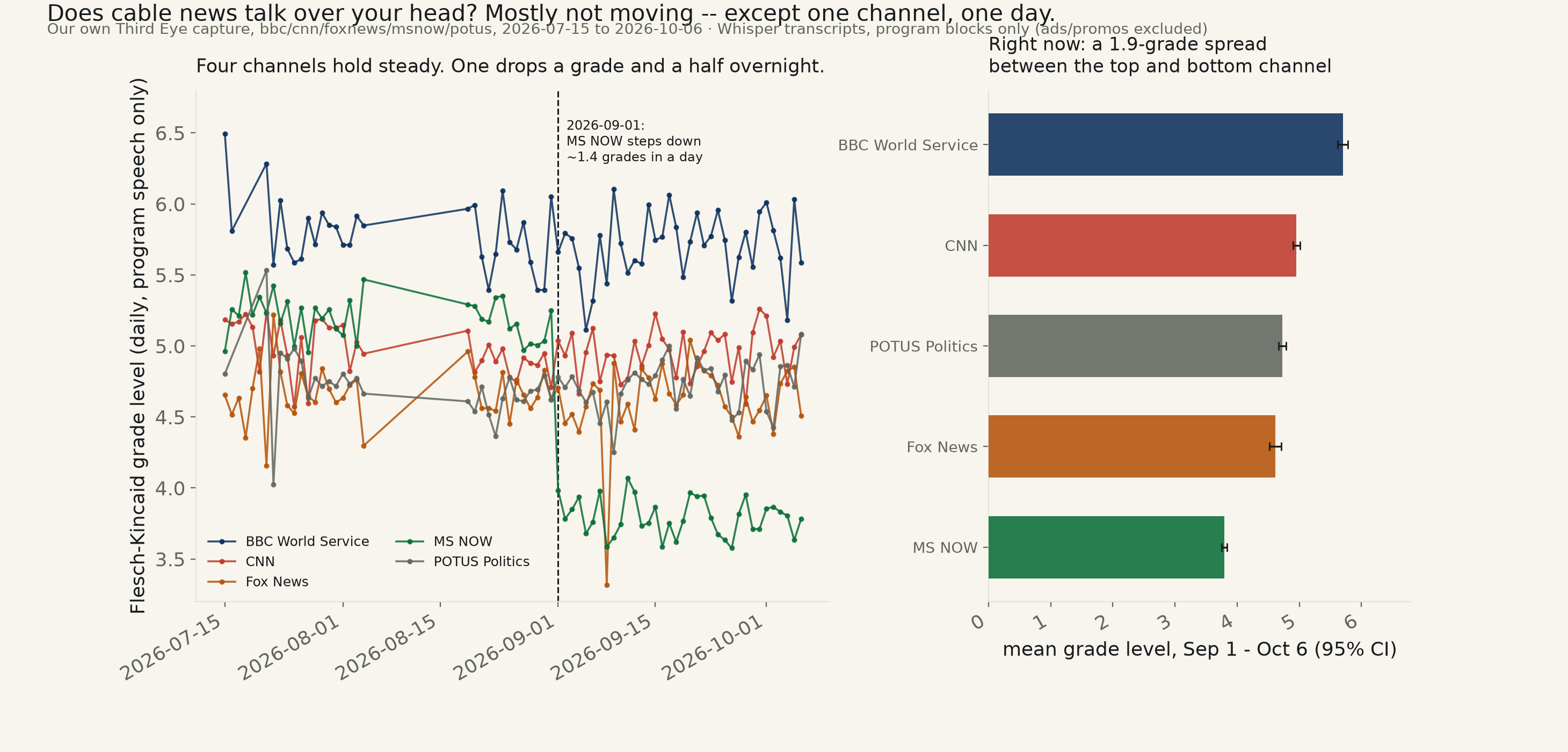
341 channel-days, our own Third Eye speech capture (bbc/cnn/foxnews/msnow/potus), Whisper transcripts of on-air program speech, ads and promos excluded. Pooled, grade level falls -0.042 grades/week, 95% CI [-0.065, -0.019] — excludes zero. But four of five channels show no trend at all; the pooled fit is carried by MS NOW alone, which drops -1.40 grades in a single day, 2026-09-01, and stays there.
Backlog idea #104 asked for Flesch-Kincaid grade level by channel from our own capture. The idea names the chyron (lower-third banner) text, but the OCR on that feed is too degraded for a linguistic metric — repeat-loop artifacts, embedded ad-read phone numbers, glyph errors ("1" for "I", "O" for "0"). This run substitutes the `utterances` table instead, the same capture pipeline's Whisper transcripts of the actual on-air speech, joined to `blocks` and restricted to kind='program' so ad and promo reads don't contaminate the text — the same kind of source substitution already on file for runs 548 and 560. Five channels, matching the idea's own count exactly: BBC World Service, CNN, Fox News, MS NOW, and POTUS Politics, 341 channel-days, 2026-07-15 to 2026-10-06 (11.9 weeks).
Pooled across all five channels, grade level falls -0.042 grades/week, 95% CI [-0.065, -0.019] — excludes zero by this desk's bar. A reader could stop there and write the headline "cable news is dumbing down." The daily series says otherwise. BBC, CNN, Fox News, and POTUS Politics each hold within half a grade of their own mean for the entire twelve weeks. MS NOW holds steady around grade 5.2 from 2026-07-15 through 2026-08-31, then drops to grade 3.6–4.0 within a single calendar day and stays there through the end of the window. That is one channel's level shift, not five channels' drift, and the pooled linear slope above is mostly MS NOW's arithmetic borrowing a trend's shape.
Pull MS NOW out and the "trend" nearly disappears. The other four channels pooled: -0.0076 grades/week, 95% CI [-0.0145, -0.0006] — barely excludes zero, p=0.032. Per channel, only BBC's own slice clears this desk's bar on its own (-0.0169 grades/week, CI [-0.0320, -0.0017], p=0.029); CNN (-0.0085, p=0.159), Fox News (-0.0026, p=0.667), and POTUS Politics (-0.0028, p=0.701) each contain zero. Four of five channels show no detectable drift, up or down, in twelve weeks of their own spoken output.
MS NOW is the whole story, and it is not a drift — it is a step. Splitting the series at 2026-09-01, the date the data itself shows a break (not a date chosen for any external reason this run can verify), MS NOW's mean grade level falls from 5.20 to 3.79, a shift of -1.40 grades, 95% CI [-1.47, -1.34], p<0.001. The same before/after split on the other four channels contains zero in every case (BBC -0.10, CI [-0.22, +0.03]; CNN -0.025; Fox News -0.049; POTUS Politics +0.008) — the break is specific to one channel, on one day, nowhere else in the capture.
Two checks against this being a capture artifact, not a real change. Whisper's own transcription confidence (avg_logprob across every utterance on the channel) is effectively unchanged across the boundary, −0.205 before vs −0.213 after — if the audio feed or the model had degraded, confidence would have moved more than that. Words per utterance did shift, 9.48 before vs 8.36 after, about 12% shorter segments on average — consistent with either shorter on-air sentences (a real editorial change) or a change in how that one channel's audio gets chunked into utterances before transcription (a capture-pipeline change specific to that feed). This run cannot distinguish the two from the data on hand, and makes no claim about which one happened — only that the shift is real, dated, and confined to MS NOW.
Read as a snapshot instead of a trend, the channel differences are large and unambiguous. Restricted to the post-break period (Sept 1 onward, so MS NOW's stale July–August era doesn't distort "how the five compare right now"): BBC 5.70, CNN 4.95, POTUS Politics 4.73, Fox News 4.61, MS NOW 3.79 — a one-way ANOVA across all five rejects equal means outright (F=404.9, p<0.001). BBC runs +1.25 grades above the US cable average (CNN/Fox News/MS NOW pooled), 95% CI [+1.11, +1.38] — excludes zero. Top to bottom, BBC to MS NOW, the spread right now is 1.91 grades.
Read plainly. There is no detectable five-channel "cable news is getting simpler" drift in twelve weeks of this capture — the one pooled fit that technically clears this desk's bar is carried almost entirely by a single channel's single-day level shift, and that shift, once isolated, is reported as what it is: large, precisely dated, unexplained, and specific to MS NOW. What is real and currently true is a wide, stable gap in register between channels — BBC's spoken register runs a full grade-plus above every US cable competitor in this capture, before or after MS NOW's break.
| Linear-trend specification | slope | 95% CI (per week) | R² | p | n |
|---|---|---|---|---|---|
| Pooled, all 5 channels | -0.0420 grade/wk | [-0.0648, -0.0192] | 0.645 | p<0.001 | 341 |
| BBC World Service | -0.0169 grade/wk | [-0.0320, -0.0017] | 0.057 | p=0.029 | 66 |
| CNN | -0.0085 grade/wk | [-0.0202, +0.0033] | 0.033 | p=0.159 | 70 |
| Fox News | -0.0026 grade/wk | [-0.0143, +0.0092] | 0.002 | p=0.667 | 70 |
| MS NOW | -0.1674 grade/wk | [-0.1953, -0.1395] | 0.732 | p<0.001 | 70 |
| POTUS Politics | -0.0028 grade/wk | [-0.0174, +0.0117] | 0.002 | p=0.701 | 65 |
| Pooled, excluding MS NOW | -0.0076 grade/wk | [-0.0145, -0.0006] | 0.803 | p=0.032 | 271 |
| Channel | mean before 09-01 | mean after 09-01 | shift | 95% CI | p | n (pre+post) |
|---|---|---|---|---|---|---|
| BBC World Service | 5.80 | 5.70 | -0.099 | [-0.222, +0.025] | p=0.109 | 30+36 |
| CNN | 4.98 | 4.95 | -0.025 | [-0.109, +0.060] | p=0.554 | 34+36 |
| Fox News | 4.66 | 4.61 | -0.049 | [-0.166, +0.068] | p=0.397 | 34+36 |
| MS NOW | 5.20 | 3.79 | -1.405 | [-1.473, -1.336] | p<0.001 | 34+36 |
| POTUS Politics | 4.72 | 4.73 | +0.008 | [-0.101, +0.117] | p=0.877 | 29+36 |
Method. Source: our own Third Eye capture pipeline's local database
(observatory.db), the utterances table (Whisper transcripts
of on-air audio) joined to blocks and restricted to
kind='program' (145,998 program blocks vs. 87,496 ad blocks and 19,734
promo blocks in the same window; ad/promo utterances are excluded entirely).
341 channel-days across bbc/cnn/foxnews/msnow/potus, 2026-07-15 to
2026-10-06 (today's partial calendar day excluded). Per channel-day: every
program-block utterance's text is tokenized into words (letter runs), sentences
(terminal punctuation groups, floor of 1), and syllables (a standard vowel-group
heuristic, the same approximation most Flesch-Kincaid implementations use), summed
across the day, then FKGL = 0.39×(words/sentences) + 11.8×(syllables/words)
− 15.59. Linear-trend regressions use OLS with Newey-West HAC(7) standard errors
(daily series, weekly program-schedule autocorrelation expected). The structural-break
split is a Welch's t-test on each channel's own pre/post-2026-09-01 subsets, unequal
variance assumed. The break date itself was found by inspection of the daily series,
not pre-registered or sourced externally.
Limits, stated plainly. The backlog idea named chyron OCR text; this run substitutes Whisper speech transcripts because the OCR text was unusable for a linguistic metric, stated above. Flesch-Kincaid is a blunt, decades-old proxy for reading difficulty, not a measure of content quality, accuracy, or sophistication, and its syllable count is a heuristic, not a dictionary lookup. "Program" block classification comes from the capture pipeline's own model-assigned labels, not a hand-reviewed set. Five channels are five editorial products with different formats, audiences, and live-vs-produced ratios; nothing here controls for topic, segment type, or guest-vs-host speech. Most importantly: this run identifies MS NOW's 2026-09-01 break precisely and rules out a transcription-confidence collapse as the cause, but it cannot determine whether the remaining explanation is an editorial change or a capture-pipeline change specific to that one channel's feed, and does not guess.
cable_readability_564.csv (channel, day, utterance count, words, sentences, syllables, Flesch-Kincaid grade) · fit output (JSON).
observatory.db — live
cable/radio audio, transcribed with Whisper, ad/promo-classified by the same pipeline's
own block model. Not a third-party dataset; no external citation applies.