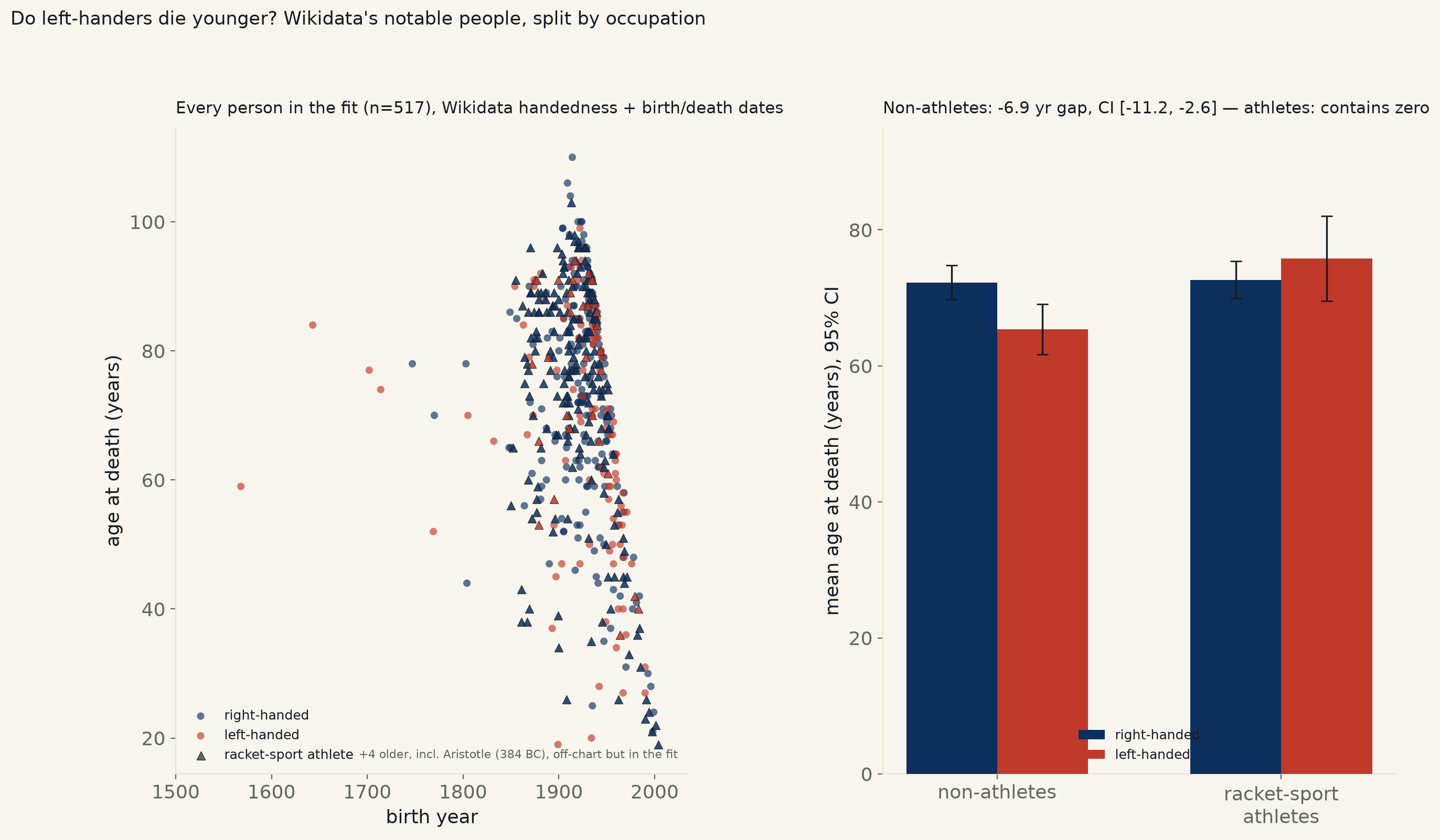
517 people in Wikidata's own handedness records, live SPARQL pull. Left-handed people in the fit died -4.74 years younger on average, 95% CI [-8.39, -1.08] — excludes zero. The textbook fix, controlling for birth year, barely moves it. The confound that actually matters: 224 of 517 entries are racket-sport athletes, where "handedness" means playing hand — split them out and the gap goes to zero for athletes and gets bigger for everyone else.
The claim traces to Diane Halpern and Stanley Coren's 1988 Nature letter: surveying the reported handedness of recently deceased people, they found left-handers had died on average about nine years younger than right-handers. The finding made headlines for years. The standard rebuttal, developed over the following decade, is that it is a birth-cohort artifact, not biology: left-handedness was actively suppressed earlier in the 20th century (children trained to write right-handed regardless of natural preference), so older decedents who were still recorded as left-handed were a smaller, different group than younger ones — a confound with birth year, not a shortened lifespan. This run tests that resolution directly on a different population: 517 people in Wikidata carrying a handedness statement (P552) alongside a birth date and death date, pulled live via SPARQL, no survey, no synthetic rows.
The naive gap is real by this desk's bar. Left-handed people in the fit (133 of them) died at a mean age of 67.7; right-handed people (384) died at 72.5 — a gap of -4.74 years, 95% CI [-8.39, -1.08], p=0.011, excludes zero. A Welch's t-test agrees (t=-2.51, p=0.013), and a 4,000-draw bootstrap puts the gap at -8.47 to -1.03 years, negative in 99.5% of resamples.
The cohort-artifact explanation predicts that controlling for birth year should shrink this gap toward zero. It doesn't. Birth year does move with handedness in the predicted direction — left-handed people in this sample have an earlier mean birth year (1890) than right-handed people (1920), slope -0.00042 per year, CI [-0.00074, -0.00009], excludes zero — but adding birth year as a control to the age-at-death regression leaves the left-handed coefficient essentially where it started: -5.01 years, CI [-8.68, -1.33], p=0.008. Birth year's own coefficient in that same regression contains zero (-0.009 yr/yr, CI [-0.023, +0.005]) — in this particular population, the textbook resolution doesn't do the work it's supposed to.
A different confound turns out to matter more: who gets a handedness statement on Wikidata in the first place. Pulling occupations alongside handedness shows 224 of 517 people are racket-sport athletes (tennis, badminton) — for them, "handedness" on Wikidata usually just records which hand they played with, a routinely documented sporting fact rather than a reported trait from a mortality survey. Splitting the sample in two reverses the obvious guess: among racket-sport athletes, the gap contains zero and even leans positive (+3.11 years, CI [-4.20, +10.43], p=0.403). Among everyone else — writers, politicians, actors, musicians — the gap is larger than the naive full-sample estimate: -6.89 years, 95% CI [-11.22, -2.56], p=0.0019, and a bootstrap on that subgroup agrees almost exactly (CI [-11.47, -2.71], negative in 99.98% of resamples). The athlete-selection story, which looked like the obvious way to explain away a Wikidata artifact, runs backward.
An era split is more equivocal. Restricted to people born before 1950 (n=424), the gap is -2.79 years, CI [-6.36, +0.77] — contains zero, though barely. Born 1950 onward (n=93), the point estimate flips positive, +3.77 years, CI [-2.67, +10.20] — also contains zero, on a much smaller slice. Neither era alone clears this desk's bar in either direction; read together with the athlete split, the honest summary is that the full-sample gap is concentrated among older, non-athlete entries rather than spread evenly across the whole dataset.
Named, for scale. The left-handed entry with the earliest birth year in the fit is Aristotle (384–322 BC, recorded left-handed on Wikidata, off the chart's axis but included in every fit above), who lived to 62. The longest-lived left-hander in the sample is Paola Veneroni, an Italian actress, dead at 99; George H. W. Bush, also left-handed, died at 94. The longest-lived person in the whole sample is Morrie Markoff, right-handed, dead at 110. Long life on either hand is possible; the fitted gap is about averages, not a prediction for any one person.
Read plainly. In this Wikidata-notable-people population, left-handed people have died measurably younger on average, the gap survives a birth-year control the standard explanation says should remove it, and splitting off the sub-population most likely to carry a "playing hand" rather than "dominant hand" record makes the remaining gap larger, not smaller. That is not a confirmation that left-handedness shortens life — Wikidata's own notable people are not a population sample, and occupation, era of fame, and cause of death are all uncontrolled here — but it is a specific, stated failure of the textbook debunking to reproduce on this dataset, reported as found rather than discarded for not matching the literature.
| Specification | gap (years) | 95% CI | R² | p | n |
|---|---|---|---|---|---|
| Naive: age at death ~ left-handed | -4.74 yr | [-8.39, -1.08] | 0.0124 | p=0.011 | 517 |
| Controlling for birth year | -5.01 yr | [-8.68, -1.33] | 0.0157 | p=0.008 | 517 |
| Pre-1950 births only | -2.79 yr | [-6.36, +0.77] | — | p=0.125 | 424 |
| 1950-onward births only | +3.77 yr | [-2.67, +10.20] | — | p=0.248 | 93 |
| Racket-sport athletes only | +3.11 yr | [-4.20, +10.43] | — | p=0.403 | 224 |
| Everyone else (non-athletes) | -6.89 yr | [-11.22, -2.56] | — | p=0.002 | 293 |
Method. Source: Wikidata Query Service
(query.wikidata.org/sparql), a single live
SPARQL query at run time for every human item (wdt:P31 wd:Q5) carrying a
handedness statement (wdt:P552) plus a birth date (wdt:P569) and
death date (wdt:P570), with occupation (wdt:P106) pulled
alongside for the athlete-confound check. 523 people matched before
filtering to unambiguous left/right-handedness (ambidexterity and "switch-hitter" are 5
rows, too few to model on their own) and dropping rows with an unparseable or implausible
(≤0 or ≥120 years) age at death, leaving n=517. "Racket-sport athlete" is
a simple string match for "tennis player," "tennis coach," or "badminton player" anywhere
in a person's pulled occupation list — a blunt proxy, not a hand-reviewed label.
Age at death is calendar-year difference (death year minus birth year), not day-precise.
OLS throughout (scipy.stats.linregress for the two-variable specs, ordinary
least squares by hand for the birth-year-controlled multiple regression); 95% CIs use the
t-distribution; the bootstrap resamples left- and right-handed age-at-death values
independently with replacement, 4,000 draws, percentile method.
Limits, stated plainly. Wikidata's notable-people population is not a sample of the general public and was never going to be: it is whoever has a Wikipedia-linked biography detailed enough that someone recorded their handedness, which this run has already shown skews heavily toward racket-sport athletes and, in the non-athlete remainder, toward writers, politicians, and performers whose fame and cause of death are both uncontrolled here. "Age at death" from calendar year alone is off by up to a year in either direction depending on birth/death month. The racket-sport flag is a text match on whatever occupations Wikidata happens to list, not a verified classification, and a handful of people plausibly have "tennis player" in their occupation list without "handedness" referring to their playing hand (coaches, for instance, are included and might reflect a reported trait instead). The era split's two halves are themselves unbalanced (424 vs 93), and no formal interaction test on whether the slope itself changed across eras was run, so the era finding is reported as two separate honest estimates, not a tested trend. This run does not reproduce Coren & Halpern's original survey design and cannot adjudicate it; it tests whether that debunk's own stated mechanism explains a gap found in a completely different, independently assembled dataset, and here it does not.
lefthanders_mortality_562.csv (name, handedness, birth date, death date, sex, occupations — 523 raw pull before filtering) · fit output (JSON).