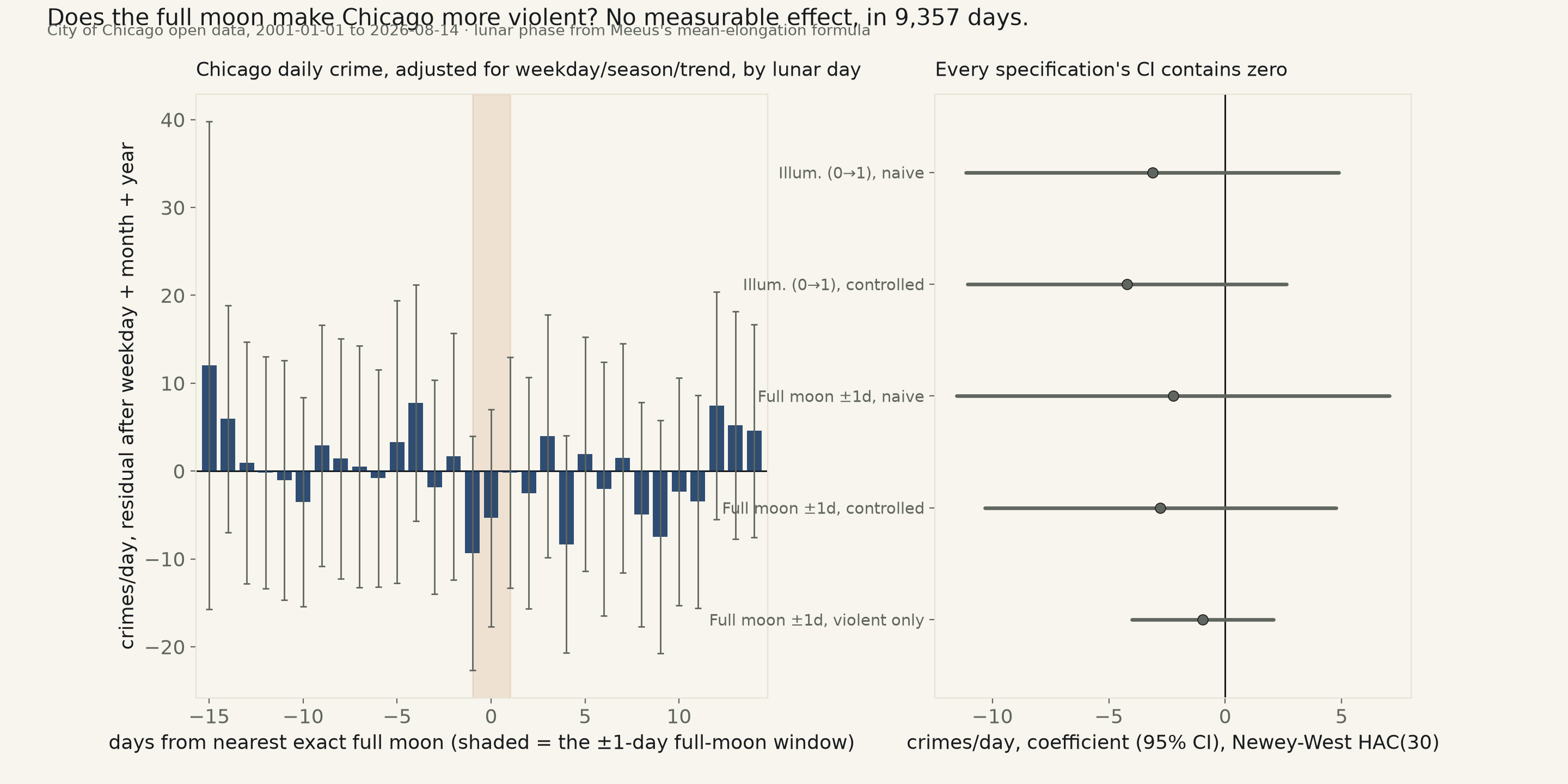
9,357 consecutive days of Chicago's own reported crime counts, matched to each day's lunar illumination fraction and its distance from the nearest exact full moon. Weekday, month and a 25-year downward trend held fixed: full-moon days track -2.79 crimes/day (95% CI [-10.33, +4.76], p=0.47) against all other days -- contains zero. Violent crime alone, the version of the claim actually in circulation, contains zero too.
"Lunacy" is in the dictionary for a reason -- the claim that the full moon drives crime, ER visits and erratic behavior is one of the oldest and most confidently repeated folk beliefs there is, still cited by police officers and ER nurses today. It is also one of the most tested: a 1985 meta-analysis (Rotton & Kelly, Psychological Bulletin) reviewed 37 studies and found no reliable lunar effect on any behavioral measure. This run re-runs the crime half directly against a real, large, modern dataset the desk had not touched before: every crime the Chicago Police Department logged over 9,357 consecutive days, 2001-01-01 to 2026-08-14 (the 30 days before the pull are held back for reporting lag, stated in the fetch script, not folded in).
Two moon measures, two crime measures, naive and controlled -- six specifications, one verdict. Chicago's daily crime count has a real weekday pattern (Friday busiest, Sunday quietest, an ~85-crime/day spread) and fell hard across 25 years (~920/day averaged over the whole window vs. ~650/day in 2025-26) -- both are held fixed in every "controlled" row via weekday and month fixed effects plus a linear year trend, all fit with Newey-West HAC standard errors (a daily count series is autocorrelated by construction; 7-, 30- and 90-day bandwidths agree to two decimal places, 30 is reported). Every single row's 95% confidence interval contains zero -- continuous lunar illumination against all crime (-4.21 crimes/day, CI [-11.07, +2.65], p=0.23), the literal "full moon window" (±1 day of the exact astronomical full moon, 634 of 9,357 days) against all crime (-2.79, CI [-10.33, +4.76], p=0.47), and the same full-moon window against violent crime alone -- homicide, sexual assault, robbery, assault, battery -- specifically, since the folk claim is about aggression, not shoplifting (-0.96, CI [-4.00, +2.08], p=0.54).
Every point estimate leans the wrong way for the myth, not just short of significance. All six coefficients above are negative -- slightly fewer crimes near a full moon, not more -- though none is distinguishable from noise. A distribution-free Spearman check agrees there's nothing here: illumination vs. daily crime count, ρ=-0.0063, p=0.54; full-moon window vs. daily count, ρ=-0.0026, p=0.81. A 4,000-draw year-block bootstrap on the headline controlled spec agrees with the parametric CI almost exactly (CI [-11.24, +5.43]) and puts only 26.6% of resampled draws on the positive side of zero -- nowhere near the desk's 95% bar in either direction.
Concrete, no regression needed: the 634 days within a day of an exact full moon averaged 919.6 crimes; the other 8,723 days averaged 921.8 -- a 2.2-crime gap, in the direction of less crime near a full moon, out of a base rate near 920/day. Violent crime alone: 269.3 on full-moon days vs. 270.1 otherwise -- a gap smaller than a single standard error.
Spearman ρ (illumination, all crime, naive) = -0.0063, p=0.54.
| Spec | n (days) | crimes/day | 95% CI | R² | Verdict |
|---|---|---|---|---|---|
| Illumination (0→1), naive | 9357 | -3.13 | [-11.13, +4.88] | 0.000 | contains zero, p=0.44 |
| Illumination (0→1), weekday+month+year controlled | 9357 | -4.21 | [-11.07, +2.65] | 0.817 | contains zero, p=0.23 |
| Full moon (±1 day), naive | 9357 | -2.24 | [-11.53, +7.06] | 0.000 | contains zero, p=0.64 |
| Full moon (±1 day), controlled | 9357 | -2.79 | [-10.33, +4.76] | 0.817 | contains zero, p=0.47 |
| Full moon (±1 day), violent crime only, controlled | 9357 | -0.96 | [-4.00, +2.08] | 0.742 | contains zero, p=0.54 |
| Illumination (0→1), violent crime only, controlled | 9357 | -2.39 | [-5.26, +0.47] | 0.742 | contains zero, p=0.10 |
Method. City of Chicago open-data portal (data.cityofchicago.org), dataset "Crimes - 2001 to Present" (Socrata resource ijzp-q8t2), queried through its public SODA API with server-side $group=day aggregation -- 9,357 days, all reported crimes and a violent-crime subset (HOMICIDE, CRIM(INAL) SEXUAL ASSAULT, ROBBERY, ASSAULT, BATTERY) pulled separately. The most recent 30 days before the 2026-09-14 pull are dropped: the portal's own dataset notes state recent weeks are still being finalized. Lunar illumination fraction and signed distance in days from the nearest exact full moon are computed for every date from the Moon's mean elongation from the Sun (Jean Meeus, Astronomical Algorithms, 2nd ed., ch. 49's low-precision polynomial) -- a deterministic astronomical calculation, not measured data, and not fitted to the crime series in any way. An internal check confirms the formula's own illumination peaks recur every 29.53 days, matching the true synodic month exactly, and mean illumination is flat across calendar months (0.497-0.501) -- lunar phase does not drift into a seasonal confound over this 25-year window.
Limits, stated plainly. This tests one city's police-logged crime counts, not psychiatric ER visits, births, or any of the other outcomes the folk claim also invokes -- those would need a different data source this run does not have. The Meeus formula used is the low-precision variant (periodic correction terms for solar/lunar orbital eccentricity are not applied), accurate to roughly a few hours around each true full moon instant -- immaterial at the day-level resolution tested here, but stated rather than assumed. Reported crime is not the same as crime committed; if lunar folklore changes what victims or officers choose to report (rather than what happens), that channel is not distinguishable from a true null in this design.
fullmoon_crime_541.csv (date, year, month, weekday, total_crimes, violent_crimes, moon_illum, days_from_full, is_full_moon_window) · fit output (JSON).