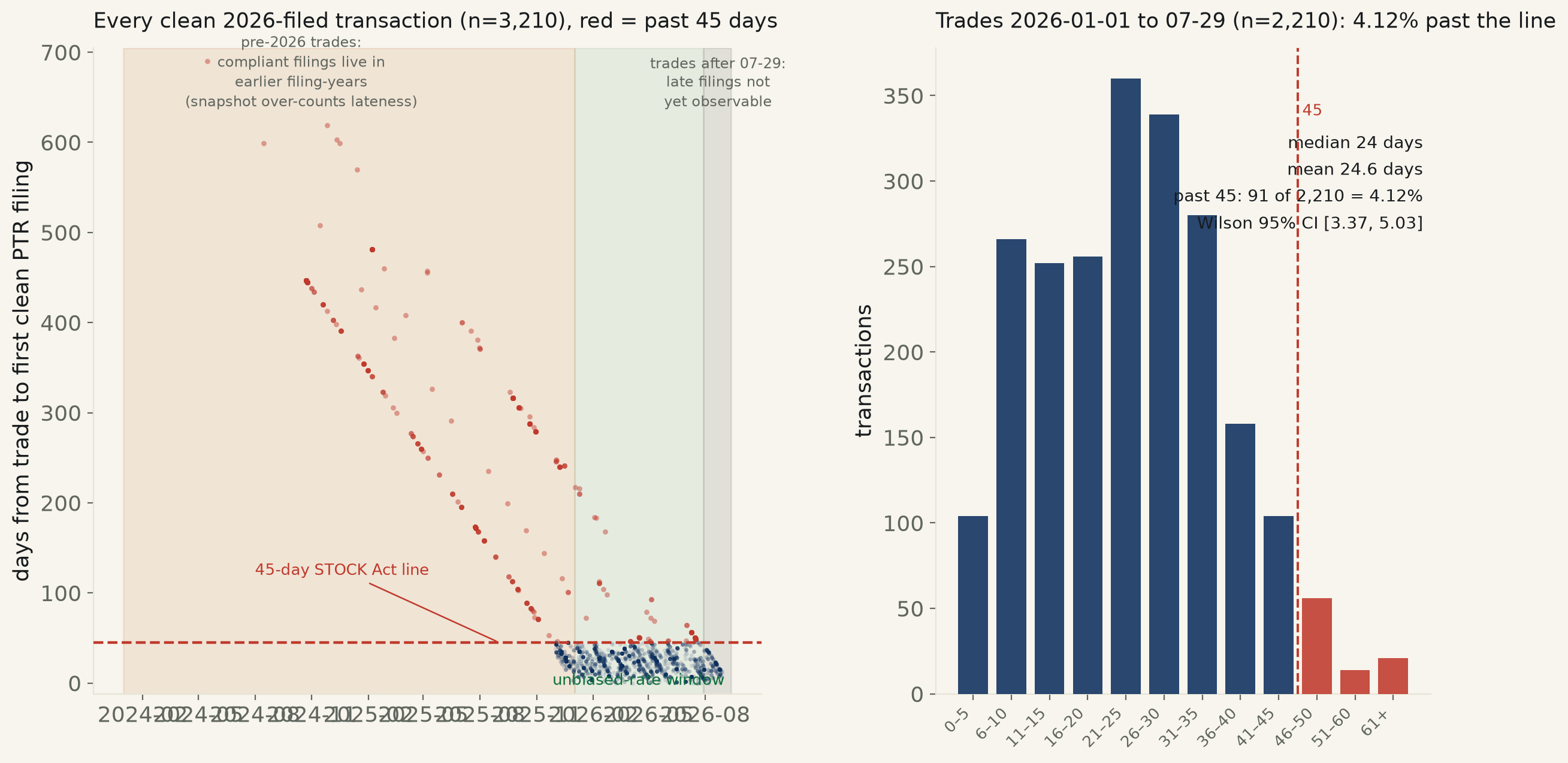
Every PTR the Clerk lists under filing-year 2026 — 385 PDFs, 3,229 transaction rows — parsed from the primary record, amendments and prior-disclosure re-filings excluded. 4.1% of the 2,210 trades dated 2026-01-01 to 07-29 crossed the 45-day STOCK Act line (Wilson 95% CI [3.4, 5.0]); the Ethics Committee’s dual clock puts it at 4.9%. Median lag 24 days. 54 of the 91 late rows are one filing. The older backlog is shorter in rows, longer in days — worst 690 days, an Apple dividend reinvestment.
Since 2012 the STOCK Act has required a member of the House to file a Periodic Transaction Report for substantially every securities trade over $1,000, and the Ethics Committee’s own PTR calculator states the deadline this run tests: reports are due “by the earlier of these two dates: (1) 30 days from being made aware of the transaction; or (2) 45 days from the transaction.” Run 015 asked a version of this question on an aggregator’s trade feed and found 89% of trades filed within 45 days; this run goes to the primary record instead — every PTR PDF the Clerk lists under filing-year 2026, 385 filings and 3,229 transaction rows, pulled 2026-09-12 from disclosures-clerk.house.gov, parsed line by line with the F/S status and comment field of every row captured, and the worst filings re-read against their PDFs by eye before any member is named below.
Four ways a naive ‘filed minus traded’ gap lies, two of them found by this run. An Amended row re-reports an old trade to correct it — not a fresh clock violation (14 rows excluded; filing 20033779, Miller, is the canonical case). A comment can say the trade was already disclosed on an annual financial disclosure — a technical re-filing, not a late one (1 row: 20034160, Jayapal, whose naive gap read 866 days). This run adds two more. The type column prints “S (partial)” for partial sales, which the obvious type-letter regex silently cannot match — 672 of 3,229 rows, 20.8% of the entire corpus, would have been dropped without ever erroring; the desk’s own first pass lost exactly those. And three rows carry internally impossible dates — a purchase dated 12/26/2026 (Cohen; filed 02/09/2026), a filing signed 06/01/2026 listing a 06/11/2026 sale (Menefee), a purchase dated 07/31/2026 filed 07/27/2026 (A. Smith) — excluded rather than resolved by guessing the filer’s intent. One Deleted row (a withdrawn transaction) is excluded too. What survives: 3,210 clean rows.
The rate, computed where the snapshot can actually see it: 4.1% of trades filed past the 45-day line. A 2026-filing-year snapshot over-counts lateness for old trades (a November 2025 trade filed promptly lives in the 2025 file, absent here; filed late, it lands here) and under-counts it for recent ones (late filings of August trades have not happened yet). So the rate is computed on trades dated 2026-01-01 through 07-29 — every such trade’s 45-day boundary closed before the pull date, and no compliant filing of it could have landed anywhere but the 2026 file. In that window: 91 of 2,210 trades, 4.12%, Wilson 95% CI [3.4, 5.0]; median lag 24 days, mean 24.6. Under the Committee’s dual clock — earlier of 30 days from the filer’s stated awareness or 45 days from the trade — 108 rows (4.9%) are late. And the lateness is concentrated, not diffuse: 54 of the 91 late rows are a single September filing by one member (Cisneros, CA31 — 37 late rows remain in 2,148 without it, 1.7%), and only 11 of the 93 e-filing members have even one late row in the window. The honest summary of the 2026 trade flow is dull: filed on time, about a month after the trade, by members who mostly never miss.
The pre-2026 backlog is where the teeth are. 726 clean rows carry trade dates from before 2026 (104 from 2024, 622 from 2025), all first appearing in 2026 filings — for every one of them the 45-day window closed before 2026 began. The worst is 690 days: an Apple dividend-reinvestment purchase traded 05/16/2024 and first filed 04/06/2026 (Case, HI01), one of seven DRIP rows in that filing whose stated notification dates are the year-end brokerage statements. Rulli (OH06) filed 32 trades spanning 07/2025–08/2026 in one batch on 08/07/2026, worst 619 days. Walberg (MI05) filed sixteen joint purchases all dated 02/07/2025 — notified, per the form, 05/29/2026 — filed 06/03/2026, 481 days. Webster (FL11) caught a single missed sale at 460 days; his filing’s own description field reads “sale inadvertently omitted.” Tran (CA45) first filed a 07/28/2025 Litecoin sale 381 days later, the form’s comment explaining the filer believed the sale was under the $1,000 threshold until preparing his annual disclosure — an explanation for the lateness, quoted here, not an exemption from it.
The two clocks cross at exactly 15 days, which is this sample’s median. The form’s notification date — when the filer says they learned of the trade — runs a median of 15 days behind the trade date (the monthly brokerage-statement cycle; 11% same-day), and filers file a median 4 days after that. Under the earlier-of rule, a member whose statement arrives d days after the trade faces the 30-day clock exactly when d=15: notify+30 = trade+45 on the same day. A member with same-day awareness (a self-directed trade) is on a stricter clock than the famous 45; a member on slow quarterly statements gets no relief past day 45 either. The 45-day line the public quotes and the clock a statement-cycle filer actually experiences are different instruments, and the Clerk’s form records both.
No OLS slope, no R², no p-value against β&sub1;=0: this run’s source is one filing-year snapshot, not a series with an exposure axis, and fitting a trend line to it would be decoration. What the data supports is a proportion with an interval — reported above with its Wilson bounds — and the distribution shown in the chart. The desk reports the shape it has.
| Cleaning stage | Rows | Note |
|---|---|---|
| PTR PDFs listed under filing-year 2026 (Clerk search, pulled 2026-09-12) | 385 | |
| − scanned paper filings, no text layer (10 members, named in Method) | -45 | unreadable, not guessed at |
| Transaction rows parsed from PDF text | 3,229 | type, both dates, F/S, comments |
| − F/S: Amended (corrections of earlier filings) | -14 | e.g. 20033779 Miller |
| − F/S: Deleted (withdrawn row) | -1 | 20035196 Hern |
| − prior-disclosure comment | -1 | 20034160 Jayapal |
| − internally impossible dates (filed before trade) | -3 | Cohen, Menefee, A. Smith |
| Clean rows (New, no exemption, dates coherent) | 3,210 | |
| subset: trades dated 2026-01-01..07-29 (the unbiased window) | 2,210 | see Method for the truncation argument |
| Trade month (2026) | n | Median lag | Rows >45d | % >45d |
|---|---|---|---|---|
| 2026-01 | 317 | 22 | 5 | 1.6% |
| 2026-02 | 339 | 27 | 9 | 2.6% |
| 2026-03 | 404 | 25 | 0 | 0.0% |
| 2026-04 | 300 | 24 | 13 | 4.3% |
| 2026-05 | 334 | 24 | 7 | 2.1% |
| 2026-06 | 266 | 26 | 2 | 0.8% |
| 2026-07 | 250 | 20 | 55 | 22.0% |
July’s spike is not a regime change: 54 of July’s late rows are the Cisneros 09/04 batch filing. February’s single late row in March’s zero is the same story at smaller scale — at these counts, one filing moves a month.
| Member | Filing | Clean rows | Rows >45d | Worst lag | Worst trade → filed | |
|---|---|---|---|---|---|---|
| 1 | Hon. Ed Case (HI01) | 20034221 | 7 | 7 | 690 | 05/16/2024 → 04/06/2026 |
| 2 | Hon. Michael Rulli (OH06) | 20035147 | 32 | 22 | 619 | 11/26/2024 → 08/07/2026 |
| 3 | Hon. Tim Walberg (MI05) | 20034660 | 16 | 15 | 481 | 02/07/2025 → 06/03/2026 |
| 4 | Hon. Daniel Webster (FL11) | 20034562 | 1 | 1 | 460 | 02/26/2025 → 06/01/2026 |
| 5 | Hon. Julie Johnson (TX32) | 20035035 | 76 | 76 | 455 | 05/07/2025 → 08/05/2026 |
| 6 | Hon. Julia Letlow (LA05) | 20030977 | 224 | 211 | 447 | 10/23/2024 → 01/13/2026 |
| 7 | Hon. Kelly Louise Morrison (MN03) | 20034213 | 10 | 8 | 437 | 01/20/2025 → 04/02/2026 |
| 8 | Hon. Valerie Hoyle (OR04) | 20034581 | 1 | 1 | 408 | 04/02/2025 → 05/15/2026 |
| 9 | Hon. Mike Kelly (PA16) | 20035203 | 5 | 1 | 391 | 07/17/2025 → 08/12/2026 |
| 10 | Hon. Derek Tran (CA45) | 20035183 | 1 | 1 | 381 | 07/28/2025 → 08/13/2026 |
| 11 | Hon. Shri Thanedar (MI13) | 20033910 | 2 | 2 | 296 | 10/21/2025 → 08/13/2026 |
| 12 | Hon. Michael Patrick Guest (MS03) | 20035130 | 5 | 3 | 241 | 12/16/2025 → 08/14/2026 |
| 13 | Hon. Richard Dean Dr McCormick (GA06) | 20033648 | 20 | 1 | 116 | 12/12/2025 → 04/07/2026 |
| 14 | Hon. Christian D. Menefee (TX18) | 20034099 | 6 | 5 | 111 | 02/10/2026 → 06/01/2026 |
| 15 | Hon. Daniel Crenshaw (TX02) | 20035024 | 8 | 2 | 79 | 04/28/2026 → 07/16/2026 |
Every filing above was opened and read before being named: the F/S flag, comment field, both date columns and the signature line checked against what the parser extracted. Filing 20034099 (Menefee) is signed 06/01/2026 yet lists a 06/11/2026 trade; that impossible row is excluded, and the filing’s other lags shown here are therefore floors.
| Member | District | Clean rows | Rows >45d in window | Worst lag (days) |
|---|---|---|---|---|
| Ed Case | HI01 | 10 | 0 | 690 |
| Michael Rulli | OH06 | 35 | 7 | 619 |
| Tim Walberg | MI05 | 16 | 1 | 481 |
| Daniel Webster | FL11 | 1 | 0 | 460 |
| Julie Johnson | TX32 | 140 | 1 | 455 |
| Julia Letlow | LA05 | 257 | 0 | 447 |
| Kelly Louise Morrison | MN03 | 49 | 1 | 437 |
| Valerie Hoyle | OR04 | 1 | 0 | 408 |
| Mike Kelly | PA16 | 20 | 0 | 391 |
| Derek Tran | CA45 | 1 | 0 | 381 |
| Shri Thanedar | MI13 | 2 | 1 | 296 |
| Michael Patrick Guest | MS03 | 9 | 0 | 241 |
| Richard Dean McCormick | GA06 | 63 | 0 | 116 |
| Christian D. Menefee | TX18 | 7 | 5 | 111 |
| Daniel Crenshaw | TX02 | 8 | 2 | 79 |
| James D Jordan | OH04 | 1 | 0 | 79 |
| Linda T. Sanchez | CA38 | 1 | 0 | 73 |
| Laurel Lee | FL15 | 6 | 3 | 69 |
| Gilbert Cisneros | CA31 | 883 | 54 | 64 |
| Richard W. Allen | GA12 | 27 | 7 | 51 |
| Scott H. Peters | CA50 | 121 | 9 | 49 |
| Jared Moskowitz | FL23 | 84 | 0 | 45 |
| Sheri Biggs | SC03 | 63 | 0 | 45 |
| Thomas H. Kean Jr | NJ07 | 58 | 0 | 45 |
| Susie Lee | NV03 | 3 | 0 | 44 |
| William R. Keating | MA09 | 19 | 0 | 44 |
| Josh Gottheimer | NJ05 | 115 | 0 | 43 |
| Neal Patrick MD, Facs Dunn | FL02 | 5 | 0 | 43 |
| Steve Cohen | TN09 | 16 | 0 | 43 |
| Jonathan Jackson | IL01 | 44 | 0 | 42 |
| Kevin Hern | OK01 | 71 | 0 | 42 |
| Rob Bresnahan | PA08 | 5 | 0 | 42 |
| Byron Donalds | FL19 | 38 | 0 | 41 |
| April McClain Delaney | MD06 | 339 | 0 | 37 |
| August Lee Pfluger II | TX11 | 11 | 0 | 37 |
| Daniel Meuser | PA09 | 7 | 0 | 37 |
| Maria Elvira Salazar | FL27 | 79 | 0 | 37 |
| Laura Friedman | CA30 | 3 | 0 | 36 |
| Dan Newhouse | WA04 | 50 | 0 | 35 |
| Lloyd Doggett | TX37 | 18 | 0 | 35 |
| Tim Moore | NC14 | 35 | 0 | 35 |
| William R. Timmons IV | SC04 | 1 | 0 | 34 |
| Jefferson Shreve | IN06 | 11 | 0 | 33 |
| Max Miller | OH07 | 16 | 0 | 33 |
| Thomas Suozzi | NY03 | 10 | 0 | 32 |
| John J Mr McGuire III | VA05 | 6 | 0 | 31 |
| Cliff Bentz | OR02 | 1 | 0 | 30 |
| John James | MI10 | 1 | 0 | 30 |
| Lisa McClain | MI09 | 5 | 0 | 30 |
| Nancy Pelosi | CA11 | 27 | 0 | 30 |
| Nicholas Begich III | AK00 | 2 | 0 | 30 |
| Ann Wagner | MO02 | 9 | 0 | 29 |
| David Rouzer | NC07 | 1 | 0 | 29 |
| Donald Sternoff Beyer Jr | VA08 | 14 | 0 | 29 |
| Greg Stanton | AZ04 | 2 | 0 | 29 |
| Chip Roy | TX21 | 2 | 0 | 28 |
| John McGuire | VA05 | 11 | 0 | 28 |
| Katherine M. Clark | MA05 | 8 | 0 | 28 |
| Brandon Gill | TX26 | 1 | 0 | 27 |
| Debbie Wasserman Schultz | FL25 | 1 | 0 | 27 |
| Dwight Evans | PA03 | 7 | 0 | 27 |
| Greg Steube | FL17 | 2 | 0 | 27 |
| Suzan K. DelBene | WA01 | 27 | 0 | 27 |
| Terri A. Sewell | AL07 | 2 | 0 | 27 |
| Cleo Fields | LA06 | 31 | 0 | 26 |
| Zoe Lofgren | CA18 | 2 | 0 | 26 |
| Doris O. Matsui | CA07 | 4 | 0 | 25 |
| Michael A. Collins Jr | GA10 | 2 | 0 | 25 |
| Virginia Foxx | NC05 | 8 | 0 | 25 |
| Roger Williams | TX25 | 4 | 0 | 24 |
| Austin Scott | GA08 | 2 | 0 | 23 |
| Elizabeth Fletcher | TX07 | 11 | 0 | 23 |
| James French Hill | AR02 | 4 | 0 | 23 |
| David J. Taylor | OH02 | 149 | 0 | 20 |
| Debbie Dingell | MI06 | 8 | 0 | 16 |
| Lori Trahan | MA03 | 10 | 0 | 15 |
| Mark Alford | MO04 | 9 | 0 | 15 |
| Rick Larsen | WA02 | 21 | 0 | 15 |
| Sara Jacobs | CA51 | 2 | 0 | 14 |
| Brian Babin | TX36 | 12 | 0 | 13 |
| Lloyd K. Smucker | PA11 | 8 | 0 | 13 |
| Scott Scott Franklin | FL18 | 3 | 0 | 13 |
| Robert J. Wittman | VA01 | 1 | 0 | 10 |
| Jennifer McClellan | VA04 | 1 | 0 | 9 |
| Sam T. Liccardo | CA16 | 1 | 0 | 6 |
| Jake Auchincloss | MA04 | 3 | 0 | 4 |
| Robert E. Latta | OH05 | 4 | 0 | 4 |
| Warren Davidson | OH08 | 1 | 0 | 2 |
| Earl Leroy Carter | GA01 | 1 | 0 | 1 |
| Matthew Robert Van Epps | TN07 | 13 | 0 | 1 |
| James A. Himes | CT04 | 3 | 0 | 0 |
| Pete Sessions | TX17 | 2 | 0 | 0 |
| Rudy C. Yakym III | IN02 | 2 | 0 | 0 |
All 93 e-filing members with at least one clean 2026-filed row, worst-lag first — the full population, not a sample. The row-level CSV behind every number on this page is published alongside it.
Method. Source: disclosures-clerk.house.gov’s public member search, FilingYear=2026 (385 filings at the 2026-09-12 pull), each PDF fetched and parsed with pdftotext -layout. Per row the parser captures the type letter and “(partial)” annotation, both date columns (transaction, notification), the F/S field, and the full C: comment including wrapped continuation lines — comments wrap across lines and even across page breaks, where the repeated column header lands mid-comment. The exclusion rules, each grounded in a filing this desk read: F/S Amended (14 rows), F/S Deleted (1), a prior-disclosure comment (1 — the only one in the corpus, Jayapal’s “Notified and Disclosed on the 2023 Federal Disclosure”), and internally impossible date orders (3). All 17 comment-bearing rows (11 distinct texts as parsed; two differ only in the capitalization of “dividend reinvestment”) were read in full; the D: description fields were swept for the same language (they describe — “dividend reinvestment,” “professionally managed account” — and in one case admit an omission, Hoyle’s “sale inadvertently omitted from PTR filed on 9/12/25,” which stays in as a genuinely late row). The worst fifteen filings in the table above were eye-verified field by field. Cross-filing repeats were checked rather than assumed: same-day same-member rows in different filings turned out to be different assets or accounts (Morrison, Taylor) or New-plus-Amended pairs (Donalds, Rouzer); one exact re-filing exists (Shreve’s JP Morgan buffer note, filed twice two days apart, both prompt) and is immaterial to every figure here.
Limits, stated plainly. 1. The paper gap. 45 of 385 filings are CCITT-scanned paper PTRs with no text layer — the entire 2026 PTR output of ten members: Harshbarger (TN01), Rogers (KY05), McCaul (TX10), Fleischmann (TN03), Wied (WI08), Khanna (CA17), Cole (OK04), Malliotakis (NY11), Mann (KS01), Self (TX03). OCR of the handwriting and stamps is not reliable enough to extract dates without inventing them, so they are excluded and named, not guessed at; paper filers plausibly skew later, and several of these are among the most active traders in the chamber, so every rate here describes e-filers and is if anything optimistic. 2. The backlog is an upper bound. A pre-2026-dated clean row is late unless the same trade was already reported in a prior filing-year’s PTR — this run cannot see 2025 filings, so some unknown share of the 726 backlog rows may be re-listings rather than first disclosures; the named worst filings were read and carry no prior-disclosure language. 3. Self-reported clocks. The notification date is the filer’s own statement of when they learned of the trade. It cannot rescue a late filing under the Committee’s rule — a later claimed notification never pushes the deadline past trade+45 — but it does drive the stricter side of the dual-clock figure, so that 4.9% is only as trustworthy as the forms. 4. The year is incomplete. The pull is 2026-09-12; filings signed after it do not exist here, which is why the rate window stops at 07-29 and why even that window’s very-late tail is thin. 5. Rows are transactions, not members — one member filing 76 trades at once counts 76 times, which is the correct unit for a per-trade disclosure rule and the wrong one for “how many members are late” (that number is in the table: 11 of 93). The Senate files on a different calendar and is out of scope.
Download the row-level data (CSV, 3,229 rows) · stats-538.json